$653 million in Campaign Contributions, Armies of Lobbyists: How Big Tech is subverting the will of the people.
This week in The Dispatch: Big Tech's lobbying machine hits $200K a day; the Sacramento money flood; Zuckerberg cries poor; and parents take the fight to Congress.

Welcome back to The Dispatch from The Tech Oversight Project, your weekly updates on all things tech accountability. Follow us on Twitter at @Tech_Oversight and @techoversight.bsky.social on Bluesky.

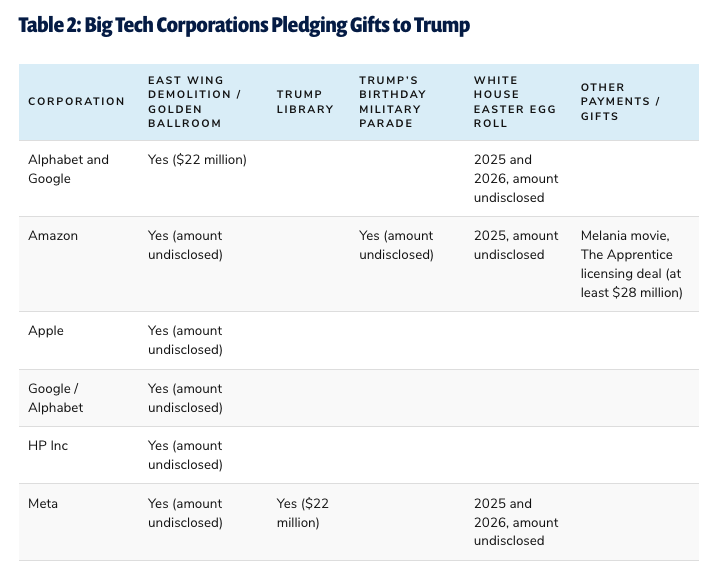
💸 BIG TECH’S POLITICAL BET: A new Public Citizen report catalogs, company by company, how the biggest names in Big Tech have sold the American people up the river by cozying up to the Trump administration over the past year. This report is THE anthology, pulling together policy reversals, love-letter quotes from Big Tech CEOs, combined political donations worth $653 million, donations to Trump pet projects, and dropped equity and inclusion commitments.
Some of you may be asking, "why go all-in and pour billions of dollars to Trump's political machine?" Well, the motivation is clear, the Trump administration has dropped or settled major investigations into serious wrong-doing by every single one of these companies, and the vast majority of the companies in the report, Google, Apple, Amazon, Meta, OpenAI, and Microsoft – among others, are pushing for blanket AI preemption, which would ban state AI laws. Thta push has the full backing of Big Tech-backed and VC-backed allies in the Trump Admin like David Sacks. It's as pay-to-play as it gets. Read and bookmark.
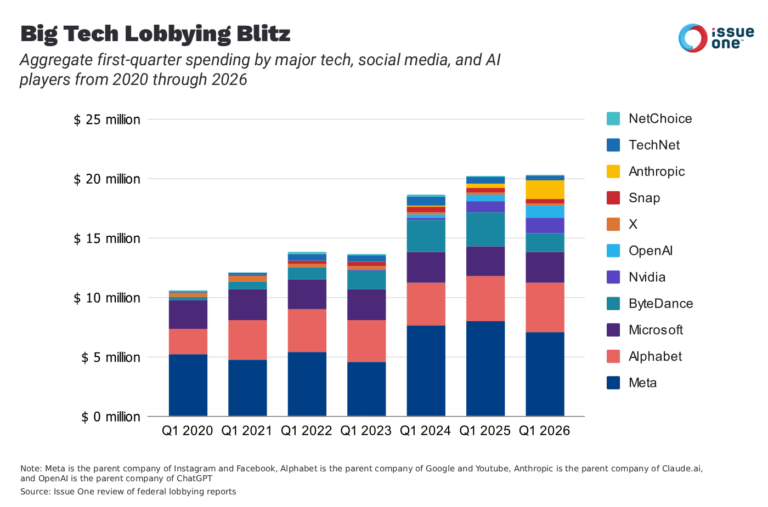
And a new analysis from Issue One puts the lobbying machine in stark relief: just 11 major tech and AI companies poured $20 million into federal lobbying in the first quarter of 2026 alone – more than $200,000 per day, including Sundays and holidays. Six of those companies employed 307 lobbyists in Q1: more than one for every two members of Congress. On top of that, they funneled more than $190 million into super PACs for the midterms. The industry has invested big in early midterm contests and is openly gearing up to spend even more to, as the report puts it, "discipline candidates who might restrain their power."
You don't spend $200,000 a day on lobbyists and $190 million on super PACs because you're confident the public is on your side. This is an industry that knows its products are unpopular, its record is indefensible, and its only path to winning is to buy the referees.

Spending on federal lobbying, first quarter of 2026:
- Meta: $7.1M
- Alphabet: $4.1M
- Microsoft: $2.6M
- Anthropic: $1.6M
- ByteDance: $1.6M
- Nvidia: $1.3M
- OpenAI: $1M
- Snap: $400K
- X: $190K
Source: Issue One

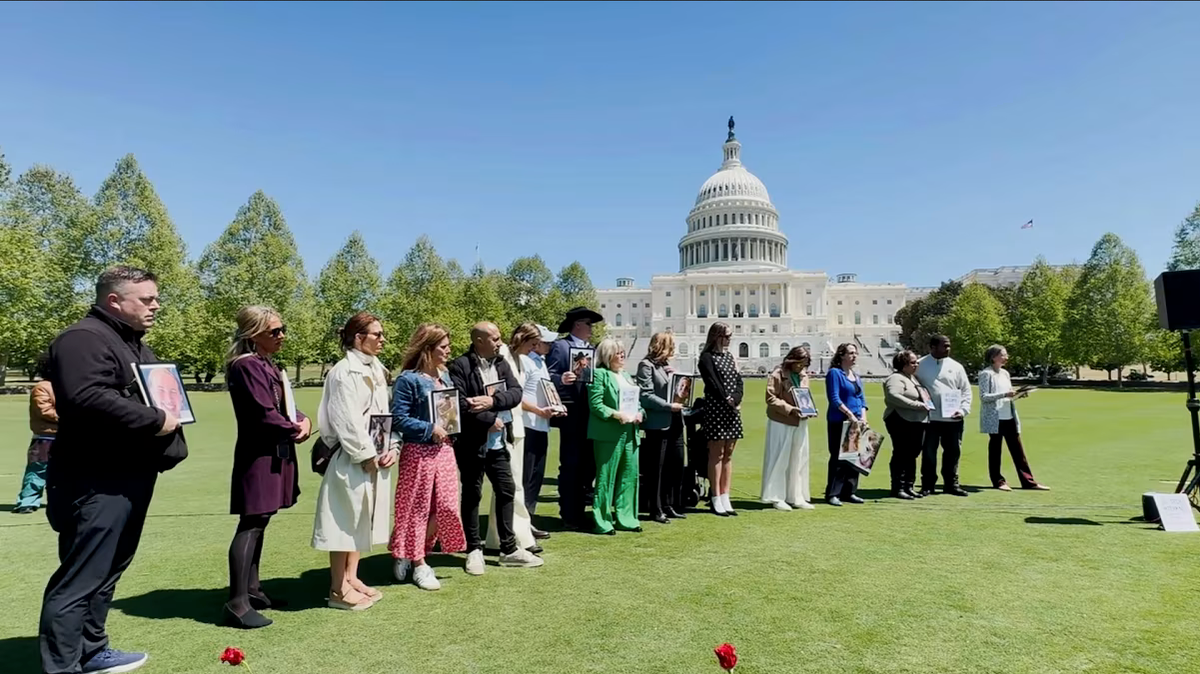
🏛️ FROM THE COURTROOM TO CONGRESS: Last week, more than 70 families came to Capitol Hill to put lawmakers on notice — some coming straight from the California and New Mexico courtrooms where juries found Meta and YouTube liable for deliberately addicting kids to their platforms.
Each parent stood on the West Lawn holding a photo of a child they had lost to harm caused by social media or AI.
Among them was Cynthia Montoya of Thornton, Colorado, holding a photo of her 13-year-old daughter Juliana. As we've covered, Juliana was groomed and sexually exploited by an AI chatbot – not a person, a bot – and died by suicide. Not one of the sexual conversations was ever initiated by Juliana. Montoya has been fighting at the Colorado State Capitol for state-level protections, which is exactly why AI preemption brought her to Washington. "If they're able to embed AI preemption, all of those efforts will make absolutely no difference," she said. "There's a potential for all that to be wiped."
Also, there was Lori Schott of Merino, Colorado, whose 18-year-old daughter Annalee died by suicide after social media destroyed her mental health. Schott was outside the courtroom when the California jury delivered its verdict against Meta and Google. Her message to Congress was unambiguous: "The evidence is in. The verdict is now. We need action. No more loopholes, no more preemption, and no more excuses."
The families spent the day meeting with lawmakers – but did not get a meeting with House Speaker Mike Johnson, despite months of trying. Ultimately, 70 families spent a single day telling their stories to lawmakers and staff who also hear from more than 300 Big Tech lobbyists on a regular basis. The choice has never been clearer: Lawmakers are either with Big Tech or families.

💰BIG SPENDERS: The scale of Big Tech's state-level influence operation in California has reached levels that would have been unthinkable just a few years ago. Between them, AI and crypto companies spent more than $39 million last year to influence California politics in 2025 — putting them ahead of oil and gas, which spent $34 million.
On top of that, filings show tech-backed super PAC California Leads spent $2.4 million on state legislative races in just four days earlier this month — targeting lawmakers who might support protecting kids, enhancing privacy, and making Big Tech pay for its own data centers.
Here's what they're up against: courtroom reckonings, a broad coalition with the facts on its side, and an electorate that isn't buying what they're selling. New research from Tech Equity found that 81% of California Democrats and 73% of Republicans support strong state AI regulations. You don't spend millions in just a few days to defend good policy.
TOP's Sacha Haworth: "Big Tech's agenda is wildly unpopular, so they're spending unprecedented money to buy influence in Sacramento, hoping to convince lawmakers to side with them over their constituents. Millions of dollars in Big Tech ads can't whitewash Google and Meta's track record of endangering children and teens and raising costs for California families."
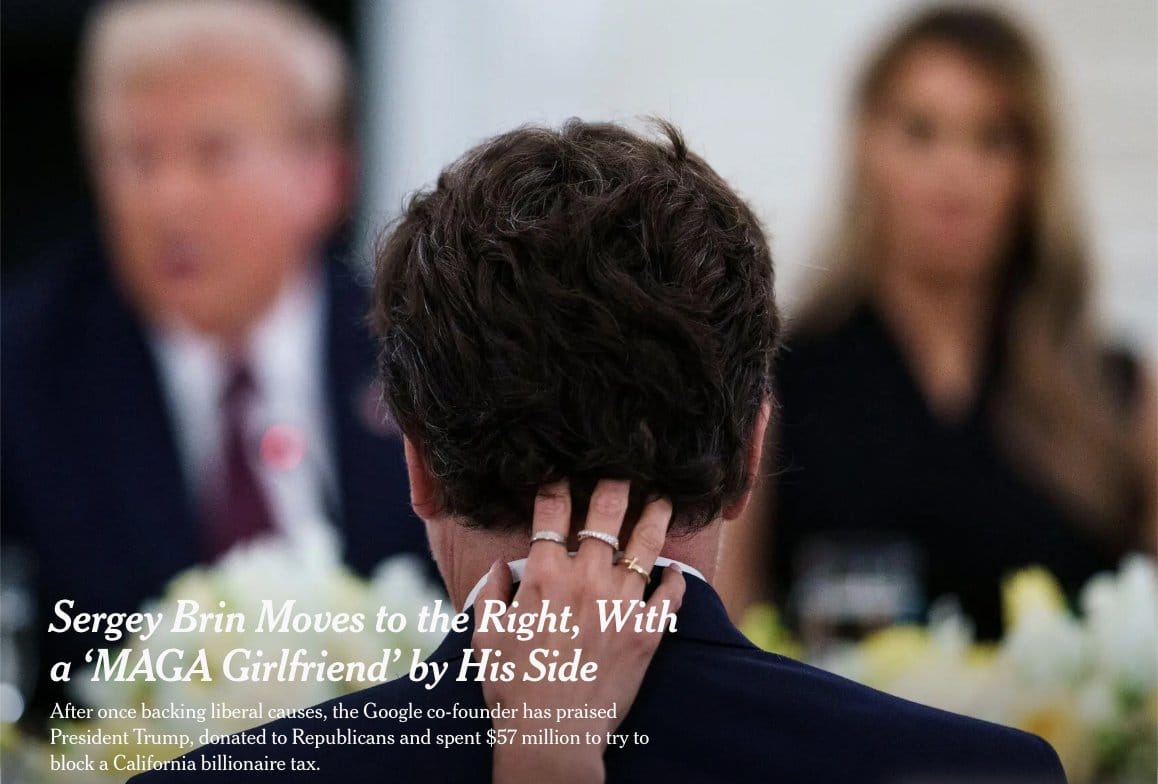
It's not just PACs upping their state-level political activity in California. The New York Times reports that Google co-founder Sergey Brin – the world's fourth-richest person – has gone full MAGA, donating to the Republican National Committee, joining a White House tech council, and backing a Republican candidate for California governor. Even the company's own employees are firing back at the sudden rightward turn, calling out Google's classified projects with the Trump Department of Defense and refusing to work with Hegseth-led agency, saying they want AI to be used to benefit humanity. The same Google that's spending millions to shape Sacramento's AI rules now has its co-founder working to reshape the entire country's politics from the top down.

OPENAI FLAPPING IN THE LEGAL WIND: As OpenAI and Microsoft try to redefine the terms of their relationship to make the Altman-led company more attractive for an IPO, Tesla, X, and SpaceX CEO Elon Musk is challenging OpenAI's for-profit push that the Microsoft deal was based on. More than just "the girls are fighting," this case represents an absolute lose-lose for the American people.
For those keeping score at home, Elon Musk was also a co-founder, alongside Sam Altman, of OpenAI and was ultimately pushed out by CEO Sam Altman and President Greg Brockman, after trying to take over the organization.
Sacha Haworth, Executive Director of The Tech Oversight Project, told the New York Times, "There’s no happy ending here."
On a potential OpenAI win, Haworth said, "It would send a signal that it’s OK to launch as a nonthreatening nonprofit working for the public’s benefit and then cynically change to a for-profit without any accountability."
On a win for Elon Musk, it could “[open] up a large share of the market that an Elon Musk company can then gobble up.” Haworth also added, "I don’t have long-term faith in a system where we’re legislating through private litigation."
According to our joint investigation with the Midas Project, OpenAI has clearly violated the original mission set out in the once-nonprofit's launch, turned its back on transparency and safety standards, and let Altman run wild with numerous conflicts of interest. That said, Elon Musk is anything but a reliable narrator.
A BETTER PATH FORWARD: The Attorneys General of California and Delaware have an important oversight role to play as OpenAI gears up for an IPO. Last year, AGs Bonta and Jennings waved through the OpenAI restructuring plan with caveats around public interest commitments and safety. As an IPO looms, its likely that corners will be cut to make OpenAI more profitable on paper. We need Bonta and Jennings to intervene and enforce the Memorandum of Understanding when evidence of wrong-doing arises.

🍽️ CRYING POOR: After losing in the landmark addiction trial last month, Meta tried to delay posting the required bond while fighting the ruling. The judge shut that down quickly, given that a company worth $1.7 trillion and flush with $200 billion in annual revenue shouldn’t have any trouble covering a $4.2 million judgment. Meta's legal team finally posted the bond — one day before the court-ordered deadline.
TOP's Sacha Haworth: "In court, Meta dragged Kaley and her family through the mud, blaming her and her parents for the harms a jury found Meta and Google to have caused. Those arguments were not only vile; they speak volumes about what Meta thinks about every young person that uses their platforms."

 NATALIA MITTELSTADT | The National News Desk
 Maddy Varner
 Emily Birnbaum and Josh Sisco and Eliyahu Kamisher
 Ryan Cooper
 Tim Murphy
 Emily Wilkins