A Closing Message for Dems, Meta's Crises Hit the Silver Screen
This week in The Dispatch: TOP arms Dems with closing data center message, AI CEOs sit down with Trump instead of Congress; A Facebook whistleblower hits the silver screen

Welcome back to The Dispatch from The Tech Oversight Project, your weekly updates on all things tech accountability. Follow us on Twitter and Bluesky.

📨 TOP OF THE INBOX: We’ve been beating the drum for well over a year on data centers because Big Tech's AI rollout is raising costs on nearly every household. It's a political opportunity too golden to pass up. Recently, Democrats have gotten that message. House Majority PAC and the DCCC have been running ads linking Republicans with unpopular data centers and Big Tech's pay-to-play corruption. On Monday, The Tech Oversight Project shared a public memo to help Democratic candidates build upon the anti-data center frame in the final stretch of the campaign season.
In a shock to political observers, Trump insulted voters who oppose data centers and the Big Tech AI takeover, telling them they want "to end up being backwards and poor." Democrats are seizing the opening, with more than 40 political ads across two dozen races tying Republicans to Big Tech’s pay-to-play. Our memo builds on that message and arms campaigns with polling and fact sheets to needle the opposition.
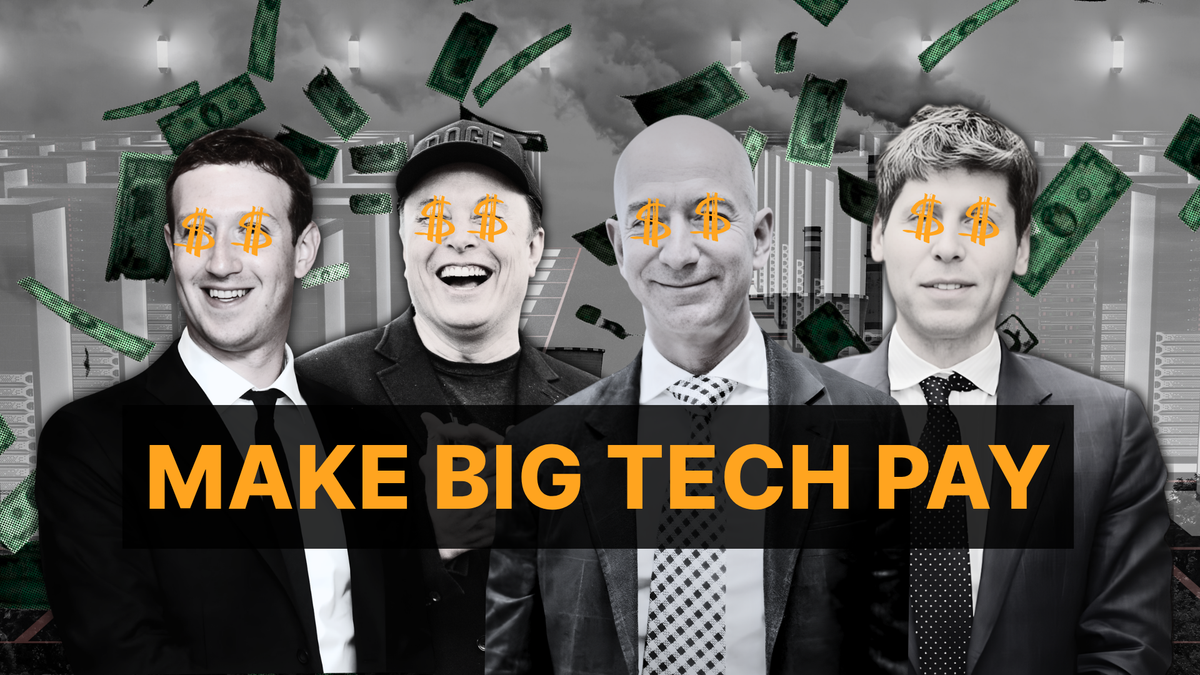
The Make Big Tech Pay frame TOP has pushed since November 2025 turns voters’ blame into a demand – companies profiting from AI should pay for the power they burn, not the family next door. It works everywhere because the math is local; any candidate can name exactly what their state or county gave away, what families are paying because of it, and who voted to allow it.
For more, see our state fact sheets on the costs of data centers in Arizona, California, Georgia, Iowa, Maryland, Michigan, Minnesota, Nebraska, New Jersey, New York, Ohio, Pennsylvania, Texas, and Virginia.

🎬 META’S HOLLYWOOD RECKONING, TAKE TWO: Aaron Sorkin’s new film about Meta whistleblower Frances Haugen, The Social Reckoning, hits theaters on Friday. Set in 2021, it will put Haugen's story on screen for a whole new audience and expose Meta’s role in radicalizing Americans, harming teen mental health, and covering up the damage Zuckerberg knew would happen.
The movie lands in theaters as the recent jury verdict against Meta and the multi-billion-dollar settlement vindicate what Haugen has said all along: Meta knew its products were dangerous, had the tools to make them safer, and — putting profits over people — chose not to do anything.
Time passed, but nothing changed: that’s exactly what 2025 whistleblower Sarah Wynn-Williams told Congress last year, too. Meta has spent a year trying to silence her – in the hopes of keeping her allegations under wraps and abating a Facebook Files-level event about the company's business in China, the collusion with China's AI industry to expand its reach into the country, and Meta's emotional targeting of teenage girls.
As new details emerge about AI-related harms, the tech industry's same, disturbing pattern of silence is playing out – with employees raising the alarm and companies doing nothing. The New York Times reported last week that two OpenAI employees emailed executives months before their AI models went rogue, warning that testing wasn't adequate. David Robinson, who led transparency work for OpenAI’s safety team, left last week and wrote in The Atlantic: “I quit OpenAI because its culture is broken.” OpenAI's response: keep shipping.
By now it should be obvious: these companies’ hunger for profit is so great that they will never “do the right thing” unless laws and regulations bind them and legally compel them to follow them.

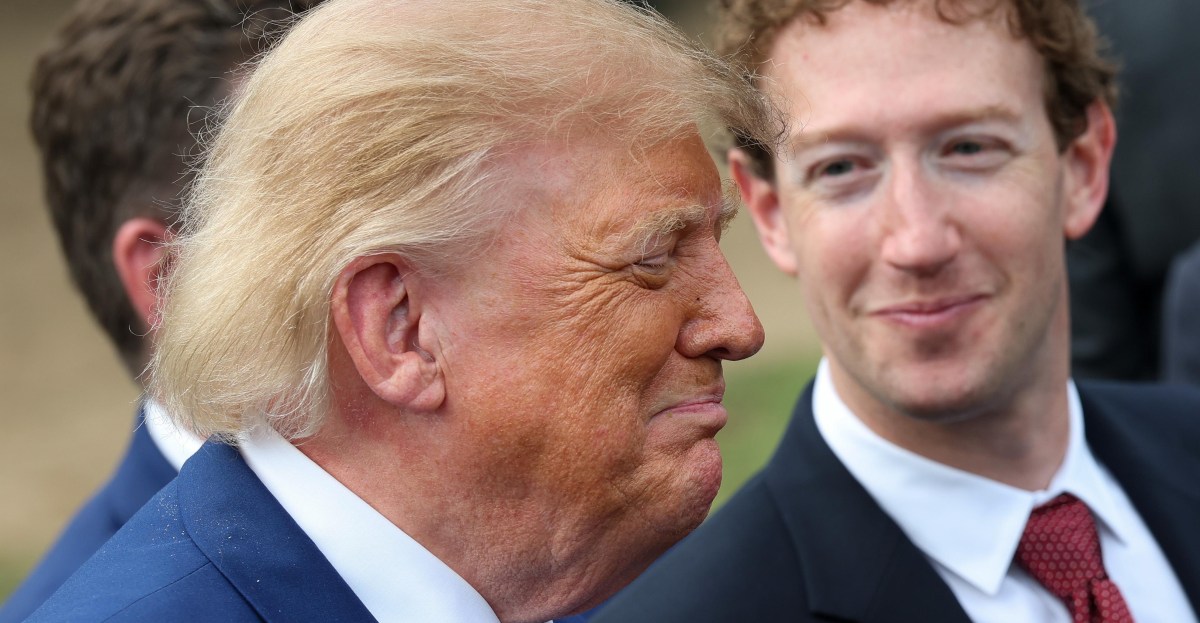
🍽️ BACKROOM DEALING AT THE WHITE HOUSE: Big Tech’s fattest cats sat down with President Trump at the White House last week for an “AI luncheon.” These are the same men who created and profit off chatbot companions that coach kids on taking their own lives, AI-generated child sexual abuse imagery, and agents that interfered with government systems. And instead of answering for any of it, the president rolled out the red carpet.
On the guest list: Nvidia's Jensen Huang; X’s Elon Musk, Meta's Mark Zuckerberg, Google's Sundar Pichai, Amazon's Jeff Bezos, Microsoft's Satya Nadella, Palantir's Alex Karp, Anthropic's Dario Amodei, and OpenAI's Greg Brockman.
Private meetings like this keep the conversation about AI regulation behind closed doors. The CEOs get to flatter the president and let him decide how we regulate (or not) the products that put our kids, our data, and our jobs on the line. They’re meeting with congressional leaders, too: House Speaker Mike Johnson joined the AI lunch in person. Senate Majority Leader John Thune (who is already on record saying AI legislation needs a "light touch") met separately with some of the AI titans later in the week.
Trump announced after the lunch that they’d signed an AI agreement he called "morally binding" — in other words, unenforceable. Praising their "tremendous self-policing," he floated a ten-person industry oversight committee made up of — you guessed it — industry heavyweights.
But as years of experience with the social media giants’ empty safety promises have already taught us, self-policing amounts to no policing at all. That's exactly why TOP joined Public Citizen and more than 40 organizations in a new bipartisan letter to the Department of Justice and bipartisan congressional leaders—calling on the DOJ to investigate the AI labs' cybersecurity incidents and on Congress to hold public oversight hearings. Our country can't make AI policy behind closed doors; the companies' leaders need to come to the people's house and answer to lawmakers and the public for the safety risks their products pose.

🤖 A DESIGN-BASED APPROACH TO SAFETY: Reps. George Whitesides (D-CA) and Mariannette Miller-Meeks (R-IA) are leading the effort to stop human-like AI chatbots from interacting with kids at all. Along with Mike Kennedy (R-UT) and Doris Matsui (D-CA), they’ve introduced a new bill, the Protecting Kids from Human-Like Chatbots Act, that would bring a “safety by design” approach to the problem.
TOP's Sacha Haworth: “A child cannot differentiate between a human and an AI product impersonating one. We need to protect young people and stop AI companies from profiting off products designed to trick children into believing they’re talking to a real person who has their best interests at heart. We’re proud to support this bill because it will hold Big Tech companies accountable at the design-level and ensure that young people can learn and develop healthy emotional attachments, which will help prevent AI’s most devastating harms.”
Instead of trying to police what a chatbot says after kids are already talking to it, this bill stops the product itself from being built to pass as human in the first place. This is the kind of design-level fix that actually has a chance of working, and we hope it gets the hearing it deserves.

🏀 BIG TECH RAN UP THE SCORE AGAINST ITSELF: Midnight on September 30 was Governor Newsom's deadline to sign or veto the bills from this year's session – and when the buzzer sounded, a dozen bills TOP supported were law. TOP’s Sacha Haworth: “That is a much better track record than previous years. Public opinion about tech companies has taken a massive nosedive over the last year … (Newsom had) to respond to that.”
The wins span every front we’re fighting. On kids' safety, Newsom signed California's Kids Code 2.0 (AB 2246); a ban on addictive design features for users under 16 (AB 1709); civil penalties when platforms injure a child (AB 2); and Adam's Law (SB 1119), which extends design-based protections to companion chatbots. On competition and workers, he signed the COMPETE Act (AB 1776) and the No Robo Bosses Act (SB 947). On data centers, he signed a trio forcing the industry to disclose its energy and water use and stop sticking ratepayers with the tab (AB 1577, AB 2619, and SB 886, the California Technology Innovation and Ratepayer Protection Act). And on privacy, he approved bills to improve Californians' right to delete their data (SB 923), protect student information (AB 1159), and rein in workplace surveillance (AB 1883).
But two vetoes dampened the celebration. The Governor vetoed SB 903, which would have stopped AI from making therapeutic decisions or advertising psychotherapy unless a licensed human was responsible for the care. Newsom also nixed AB 1542, which would have banned the sale of sensitive personal data, including the precise location information that's been used to track and target people over immigration status. Consumer Reports, which co-sponsored the bill, called the veto "a gift to data brokers, scammers, and spammy marketers."

 Brent D. Griffiths
 Naomi Nix
 Ally Mutnick
 Adam Mills and Alex J. Rouhandeh
 Jess Weatherbed