Big Tech Lost the First AI Election
This week in The Dispatch: What the industry’s big loss means for tech policy; keeping industry’s friends away from the gavels; Google's school-day hostage standoff.

Welcome back to The Dispatch from The Tech Oversight Project, your weekly updates on all things tech accountability. Follow us on Twitter and Bluesky.

Sacha Haworth, Founder and CEO of The Tech Oversight Project, joined NewsNation to break down the 2026 midterm election results and discuss how tech and AI accountability came out a big winner. "If you had told me a year ago, or even six months ago, that winning campaigns up and down the ballot across the country were going to be running on a tech accountability message, I probably would've looked at you like you had five heads."

🔜 A TECH ACCOUNTABILITY MANDATE: Last week was the first AI and tech accountability election, and Big Tech lost not only key races but also the plot. Candidates in 136 races for House, Senate, and governor put AI, tech, and data center policies front and center. According to NBC News/SSRS’s exit poll, voters who called AI and data centers "crucial" to their vote broke for Democrats by 40 points.
Winning Democrats made tech accountability central to their campaigns, flipping seats that weren’t in play until recently:
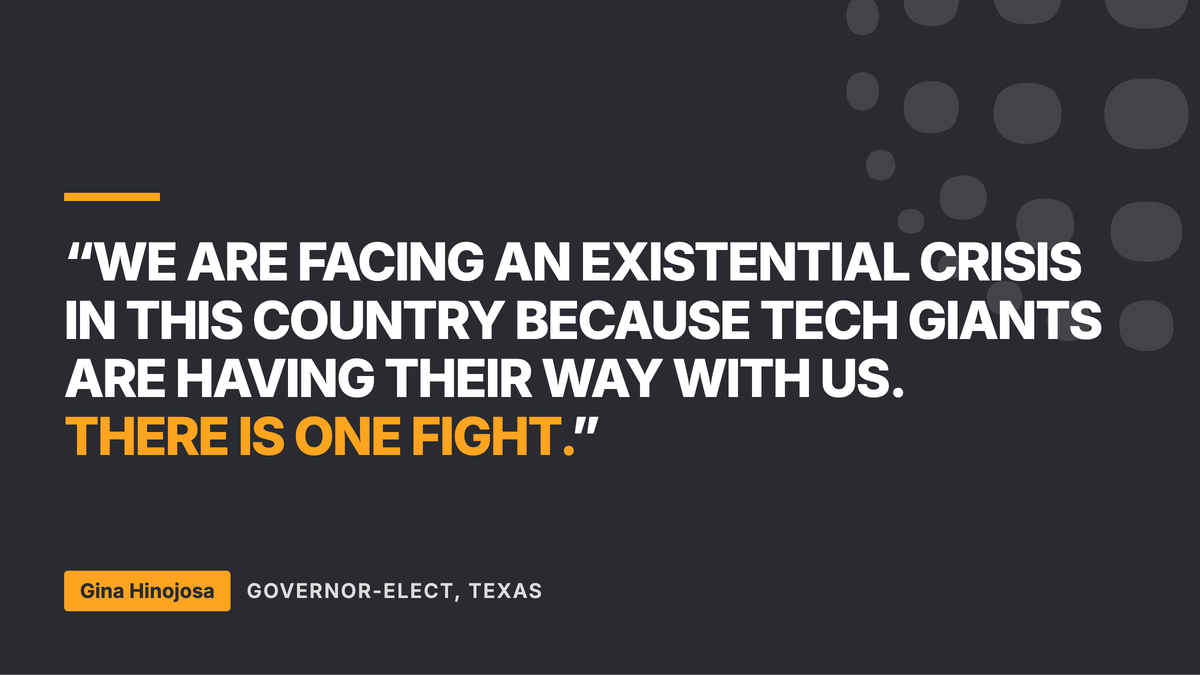
- TEXAS: James Talarico called for ending “sweetheart tax deals” for Big Tech and beat Ken Paxton, turning a Texas Senate seat blue for the first time since 1988. Gina Hinojosa beat sitting Governor Greg Abbott on a promise to pause data center development in one of the industry's favorite states, saying, “We are facing an existential crisis in this country because tech giants are having their way with us.”
- OHIO: Sherrod Brown ran millions of dollars in ads calling Jon Husted "the face of data centers in Ohio" and won by five points – a comeback defeat to the big-money intimidation strategy that thought making an example of him in 2024 would keep other Democrats toeing the corporate line. An August NRSC memo had conceded that "more than any other thing in this race, data centers are the anchor hanging around Husted's neck."
- MICHIGAN: Abdul El-Sayed said AI was the most important issue going into Election Day and beat Mike Rogers — and in MI-07, Will Lawrence made Big Tech accountability his core message and took down an incumbent.
- GEORGIA: Sen. Jon Ossoff, who ran on his online safety record and his fights with Big Tech, held his seat. In his victory speech, he warned: “The titans of Silicon Valley dig bunkers for themselves and warn that the artificial intelligence they’re creating risks human extinction.”
- IOWA: Josh Turek, who ran on Big Tech’s threat to the rural economy and farmland, beat Rep. Ashley Hinson and flipped Iowa’s Senate seat.
- SOUTH CAROLINA: Annie Andrews nicknamed her opponent “Data Center Darline,” called for a two-year moratorium on new projects, and beat Darline Graham, whom a pro-data center super PAC tied to Leading the Future had spent heavily to support. NYT’s Teddy Schleifer wrote that Darline Graham’s loss “is a black eye for the data-center industry.”

🔵 BIG TECH SAYS THEY PLAY FOR THE BLUE TEAM NOW: As members-elect arrived in Washington D.C., this week for new member orientation, the tech giants were already trying to shape-shift. Meta is reportedly building a bipartisan team to court the new majority. OpenAI is planning a post-midterm PR offensive that includes rebranding data centers as "AI compute campuses." And the Chamber of Progress — funded by OpenAI, Apple, Amazon, and Google — is pressing Democrats to point their new oversight power toward the Trump administration… and away from Big Tech. Its CEO, former top Google lobbyist Adam Kovacevich, said he hopes Democrats “aim oversight at the Trump administration and not business.” That ask is a tell: they're playing hide the ball so Big Tech CEOs don't get called out for open-air corruption under Trump.
Big Tech CEOs: We’re Dems now!
The worst thing Democrats could do right now is return to business as usual with Big Tech. The play is to use the gavel, get the CEOs under oath, and refuse to trade it all back for a Palo Alto fundraiser. Oversight hearings should demand answers from those CEOs about what their algorithms and AI chatbots do to kids, what they promised to land data center deals, what they counted on getting for the checks they wrote to Trump. Put parents and advocates at the witness table, too. Incoming Congressional Progressive Caucus Chair Greg Casar has already called for Big Tech’s CEOs to testify under oath.
The mandate is real, and the first hundred days will tell America whether the new majority will govern accordingly. They should – people across the country are crying out for change, and the movement that powered this election will only be bigger in 2028.

🪑 LEADERSHIP MATTERS: The gavels chosen in the coming days will steer AI policy for the next two years. Last week, TOP led more than 50 organizations working on AI safety in a letter to congressional Democratic leadership, reported in the Washington Post, urging them to elevate members strong on AI safety to the committee posts that will decide whether the voters' mandate becomes law.
The companies that spent two years bending the knee to Trump would love friendly faces who treat their talking points as consensus. Candidates for chair should be measured against three standards: support for mandatory, binding AI regulation; opposition to state AI law preemption; and independence from anti-regulatory super PACs like Leading the Future.

🏫 PARENTS PUSH BACK: In a story that broke through the noise and sparked widespread condemnation the morning of Election Day, the New York Times reported that Google warned K-12 schools that reject AI that they'd lose access to Google Search entirely — because, the company claimed, AI is "built into" Search and can't be switched off.
That leaves every school in America to choose between feeding its students into Google’s AI or cutting them off from the world’s dominant search engine. That’s a hostage situation, and after the story broke and parents, teachers, and elected officials erupted, Google scrambled to repackage the plan.
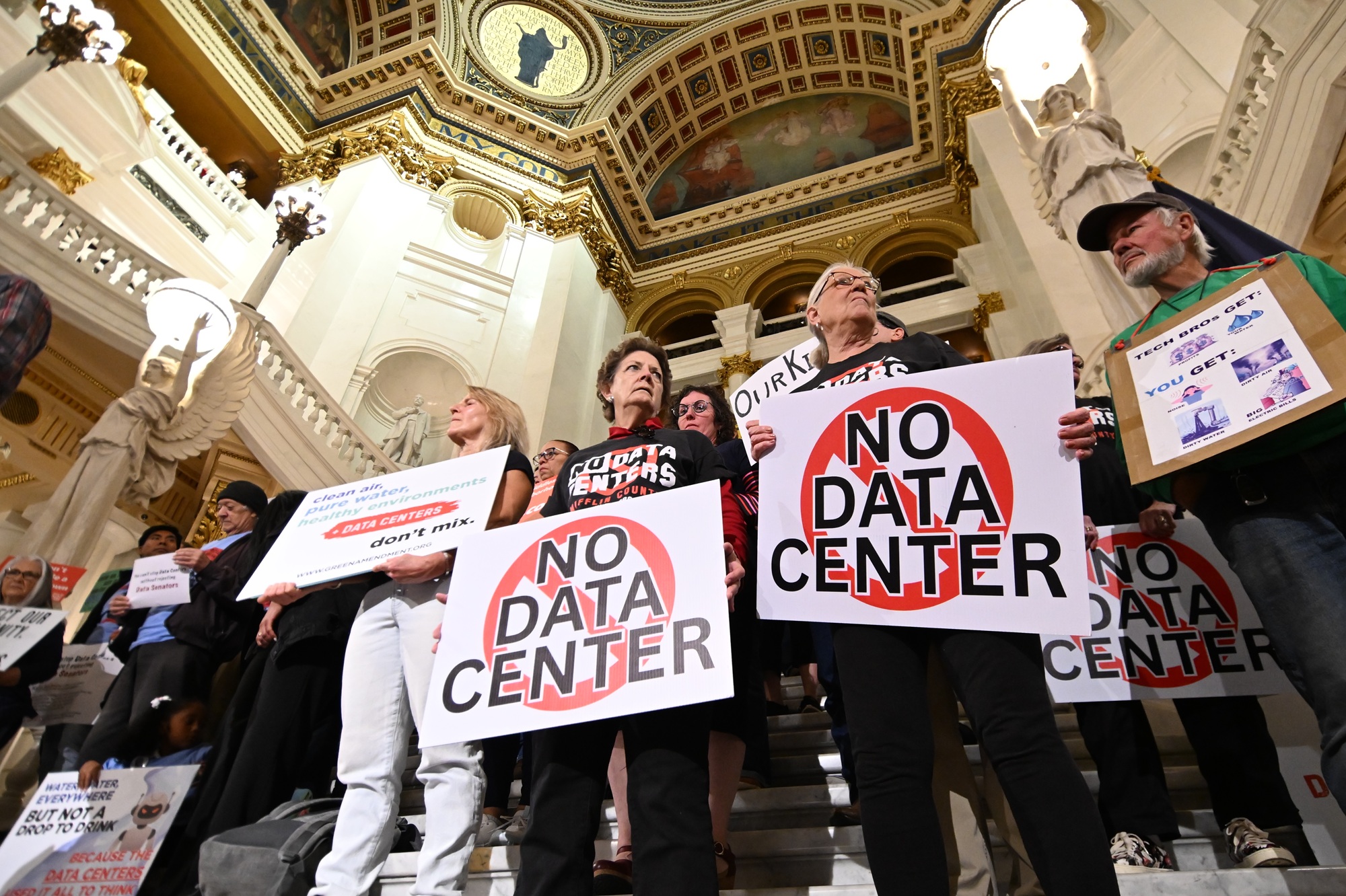
The tech-in-schools fight is happening now. Parents, teachers, and school boards are furious about Big Tech companies’ aggressive AI push and rampant data collection in classrooms. The new Congress, newly state lawmakers in all fifty states, and the roughly dozen state Attorneys General that campaigned on tech accountability will all be watching – and asking hard questions that are long overdue.
The reckoning is coming for Google, and for every tech company that sidelines teachers to push products into classrooms for profit. Across the country, school districts are suing Big Tech over the harm its platforms do to students, and the documents coming out of those cases have laid bare how hard the companies worked to hook kids — including buying influence with the groups meant to speak for parents. TikTok paid the National PTA $3 million to promote its youth-safety efforts and supply “positive” quotes to reporters; Meta bankrolled the group for years; and Google — the company now squeezing schools over Search — funds the PTA’s “Be Internet Awesome” programming. The suits turn that playbook into a legal charge, accusing the companies of infiltrating school communities by paying education organizations to legitimize their platforms, in a case they liken to Big Tobacco. The scrutiny is starting to bite: the PTA cut ties with Meta earlier this year as the evidence piled up, and advocates are pressing it to drop TikTok and Google, too.
Big Tech knows the risk: it paid to settle the very first case — brought by a small Kentucky district — rather than let it reach a jury. But the districts aren’t backing down, and the next two, Tucson and Charleston County, head to trial in early February. Google's message to schools this month was: accept our AI, or your kids pay the price. Americans who care about our kids aren’t buying it.

 James Baratta, Whitney Curry Wimbish
 Guardian staff reporter

 Julia Love

 Richard Woods

 Kate Taylor