Meta Wants to Co-Opt KOSA to Get Out of Court, D-Day for 2026's Marquee AI Super PAC Primary
Subhead: This week in The Dispatch: Meta schemes to gut KOSA from the inside; Big Tech money reshapes the NY-12 race; and New Jersey advances real kids' safety leadership.


Welcome back to The Dispatch from The Tech Oversight Project, your weekly updates on all things tech accountability. Follow us on Twitter at @Tech_Oversight and @techoversight.bsky.social on Bluesky.

REMEMBERING SOCIAL MEDIA VICTIMS: Today is Social Media Victims Remembrance Day, and parents, families, and advocates are gathering in Washington, DC and Sacramento, CA to honor the memory of young people who have lost their lives to social media harms. The annual observance is organized by two survivor moms, Amy Neville and Kristin Bride, who tragically lost their sons on the same day in 2020, and is dedicated to remembering social media’s victims and to changing the system through awareness and education.

If you are in the D.C. area, please consider coming out to Upper Senate Park from 4–5 PM today for a public memorial viewing to stand with parents, honor children, and support families and their calls for change.

💉 THE ANTIDOTE TO BIG TECH'S TRIAL WOES? POISON PILLS FOR KOSA: In New Mexico and California courts (with more to come), Meta is finally facing consequences for what its own documents prove it knew all along: they were recklessly endangering kids and purposefully designing its products to be addictive. Their response to long-awaited accountability? Adding poison pills to gold-standard online safety legislation, namely the Senate's version of KOSA.
⏩ GETTING UP TO SPEED: As readers of The Dispatch know, the Senate's version of KOSA holds Big Tech accountable by forcing the companies to protect children and teens, redesign products to remove addictive features, and provide transparency into trust and safety programs. The bipartisan Senate version of KOSA is also cosponsored by over 75 Senators and supported by over 250+ organizations.
Last week, reporting from Reuters showed that Meta, in particular, is trying to add poison pills to the bill that would stop the thousands of existing social media addiction cases dead in their tracks, grant Big Tech sweeping immunity, and block new ones from ever being filed in federal and state courts. Julia Duncan of the American Association for Justice: “The language is pretty clear-cut immunity against every parent, every school district, that is seeking to hold any AI or social media company accountable for harm” to a child. This is a breathtaking show of cynicism from Meta – full stop.
⏪ REWIND: Meta lost big earlier this year, with a jury finding the company liable for knowing features like infinite scroll and addictive notifications were dangerous — and pushing them on our kids anyway. Thousands more lawsuits are pending. Letting Meta kill all of them via an end run in Congress would signal to the entire industry not only that the federal government isn’t serious about protecting kids, but that it won’t let states do it, either. It would be a free-for-all: profitmaxxing would ramp up even faster, more families would see their lives upended, and more children would die.
➡️ STATE OF PLAY: Big Concerns for Congress: In the last 24 hours, the House Energy and Commerce Committee announced a supposed deal for online safety legislation. The problem? The bill doesn't actually force Big Tech companies to protect, and Senate sponsors of KOSA are already lining up to oppose the House's tech-friendly approach – making the path forward rocky at best. For those keeping score at home, The Tech Oversight Project, Parents Rise, Design it For Us, and a coalition of over 100+ survivor parent, online safety, youth, and watchdog groups wrote to the House Energy and Commerce Committee asking them to ditch its approach because their bill didn't provide a duty of care. The new "deal" still doesn't. Senator Richard Blumenthal, co-author of KOSA, said, "The House’s toothless & tepid capitulation is dead in the Senate & a betrayal of families suffering from Big Tech’s greed." We couldn't agree more.
➡️ STATE OF PLAY: A Parentless Negotiating Table: As advocates push for a clean version of Senate KOSA, Big Tech attempts to advance toothless safety bills, and the White House tries for a grand deal on AI preemption that uses some version of KOSA as a bargaining chip, it would appear that survivor parents are being locked out of negotiations, per reporting from Punchbowl. This is a concerning development that raises real questions about what Senator Marsha Blackburn is negotiating with the White House, the version of AI preemption that could be on the table, and whether or not core elements of KOSA are on the chopping block.

👀 ALL EYES ON NY-12: As New Yorkers head to the polls today, what was supposed to be an easy demonstration of AI industry muscle in one race has led to an enormous blowback.
Leading the Future has unilaterally spent millions trying to make an example out of Alex Bores, one of the country's most prominent advocates for AI safety legislation. Instead, they may have given him exactly what every underdog candidate needs: attention and instant credentials. This may end of one of the most clear examples of the Streisand Effect in electoral history.
Leading the Future poured “lighter fluid” on the race, transforming Bores from a low-profile state assemblymember into a national figure, and earning him major media coverage and endorsements from a wide range of labor, left, and advocacy groups who see him as a symbol of resistance against Big Tech overreach. They also drove heavy spending from the other side: there’s now been more money spent for Bores than against him.
Bores leaned into it, releasing an ad in the campaign's closing days that framed the race as a choice between New Yorkers and the billionaire-backed AI super PACs trying to buy it. Rather than running away from the attacks, he made them part of his closing argument to voters.
🚨NEW AD: In the final days, @AlexBores is focusing on how he’ll stand up to powerful Big Tech companies and speak truth to power.
— The Tech Oversight Project (@Tech_Oversight) June 18, 2026
Matthew and Maria Raine join to share their story of ChatGPT coaching their son Adam to take his own life. Powerful. pic.twitter.com/f40ticzmyP
Sacha Haworth, Executive Director of The Tech Oversight Project, told Politico, "You have to put up what you can to fight off the deep-pocketed infinite resources of Big Tech. I’m glad that the AI safety side and the pro-worker side was able to marshal resources to fight back — and that counterattack absolutely made a difference, and that’s what’s going to continue to happen."
Even record amounts of Big Tech money can’t necessarily overcome voters’ strong feelings that the tech and AI giants are due for a reckoning. By spending so heavily, the industry may have only reminded voters how much power they still have. "[Leading the Future and Big Tech] have toxified themselves by thinking they can throw a bunch of money at the problem and it could go away," Haworth added.

💪 NJ STRONG: Kids Safety Edition: Advocates are hopeful that New Jersey’s Kids Code Act will receive floor votes before the end of the legislative session after passing out of a Senate committee with a decisive vote. The bill (S3413), which is moving alongside a social media warning labels bill (S3412), would establish strong privacy and safety-by-design protections for young people online. Unlike industry-backed alternatives, this bill holds companies responsible for the design choices they make, and it includes a private right of action, making it one of the strongest children's online safety proposals in the country.

Governor Mikie Sherrill, who campaigned on kids' online safety, has made it a core issue, elevating the conversation into the broader public debate. Other governors should take note: pushing for meaningful tech accountability is a commonsense and popular response to a problem parents, educators, pediatricians, and policymakers increasingly agree is real.

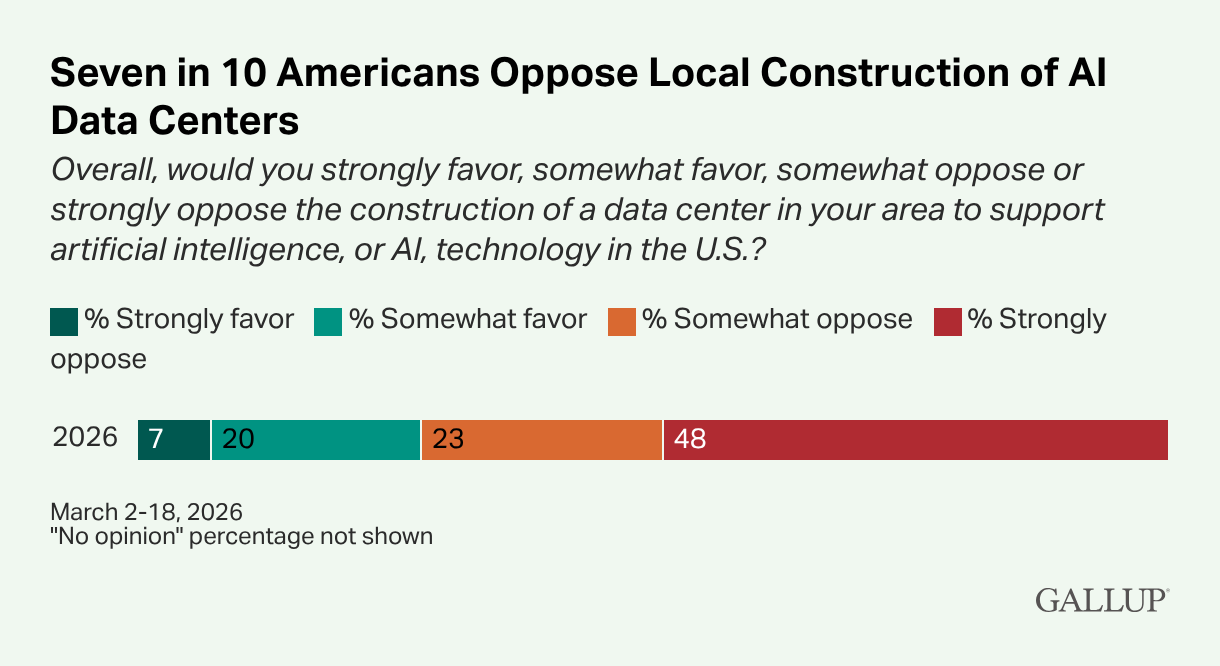
❌ TRUMP ON THE WRONG SIDE OF DATA CENTER POLICY: As communities across the country demand answers about the energy, water, and economic impacts of the AI boom, the Trump administration is running away from the problem: they’re allowing the Federal Data Center Enhancement Act, a key framework governing how federal agencies track and manage data center operations, to expire without a replacement plan.
The law required agencies to monitor issues like energy efficiency, water use, and sustainability. Now, federal officials and former government employees are warning that there appears to be no roadmap for what comes next, even as public concern about all those issues is driving opposition to data centers to its highest level ever. Washington’s response, apparently: ask questions never.

 Ben Wieder
 Rebecca C. Lewis and Annie McDonough and Sophie Krichevsky and Jeff Coltin and Fariha Rahman
 AJ Ernst
 Stevie Bonifield
 Hugo Lowell
 Mark Hertsgaard