
STATEMENT: The Tech Oversight Project Heralds Verdict in Social Media Addiction Trials as an Earthquake for Big Tech

LOS ANGELES, CA – Today, The Tech Oversight Project issued the following statement after a verdict was handed down in the first case in the social media addiction trials. This was the first product liability case to go to trial that any Big Tech company has faced and was brought forward by plaintiff K.G.M., who experienced dangerous mental health harms after becoming addicted to social media platforms run by defendants Meta and YouTube. Her case against TikTok and Snap was settled before the trial began.
“The era of Big Tech invincibility is over – this ruling is an earthquake that shakes Big Tech’s predatory business model to its core. After years of gaslighting from companies like Google and Meta, new evidence and testimony have pulled back the curtain and validated the harms young people and parents have been telling the world about for years. These products were purposefully designed to harm, addict millions of young people, and lead to lifelong mental health consequences,” said Sacha Haworth, Executive Director of The Tech Oversight Project. “This trial was proof that if you put CEOs like Mark Zuckerberg on the stand before a judge and jury of their peers, the tech industry’s wanton disregard for people will be on full display. We have the documents, we have the evidence, and now is the time for Congress to step up and finally pass the Senate’s Kids Online Safety Act, so that we can finally protect kids and save lives.”
More than 2,000 plaintiffs are alleging social media companies like Meta, Snapchat, TikTok, and Alphabet knowingly designed addictive products that expose children to predators, exploitation, and self-harm. The trials are considered the most significant Big Tech accountability litigation to date, drawing parallels to precedent-setting products liability cases against Big Tobacco.
The evidence now in the public record shows how companies knowingly engineered products with design features such as infinite scroll, push notifications, and algorithmic amplification. For Big Tech companies, youth engagement is a financial imperative. Social media platforms generate billions in annual ad revenue from U.S. youth. According to new Pew Research Center survey data, 36% of U.S. teens say they use TikTok, YouTube, Instagram, Snapchat, and/or Facebook "almost constantly."
The trials have already produced an unprecedented public record of damning internal company documents.
The Evidence Against Meta
“Hook them young” “The young ones are the best ones”
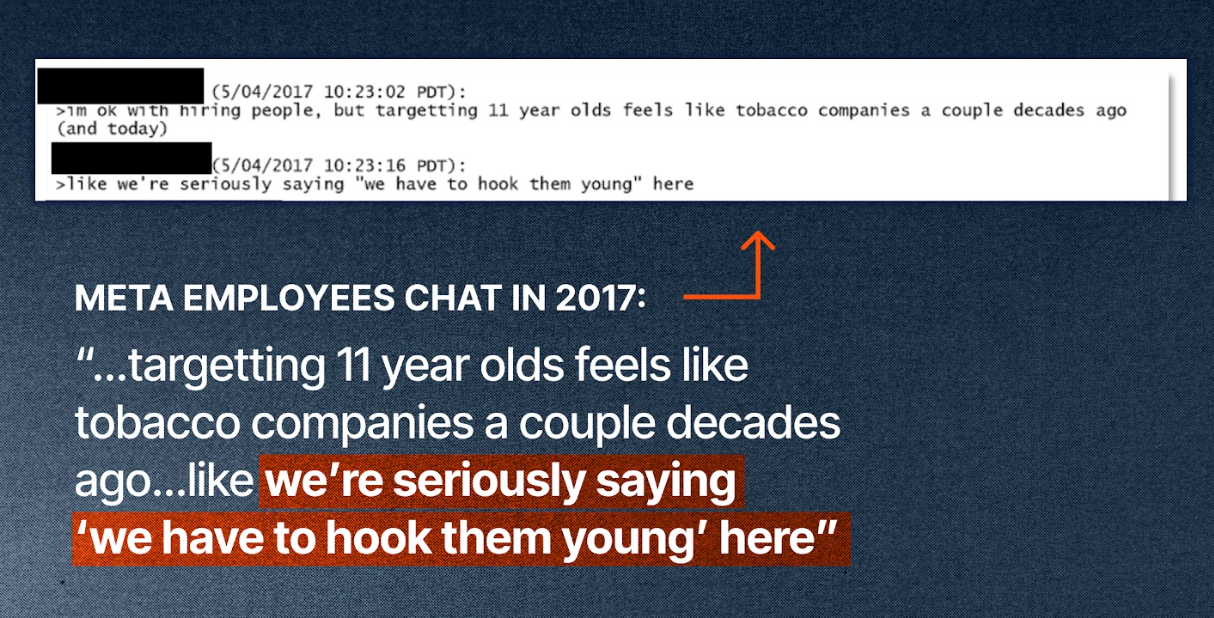
An internal report stated "The young ones are the best ones" regarding long-term retention. Internal business plans targeted teens as the “gateway” to hook other families. Another internal report estimated "the lifetime value of a 13 y/o teen is roughly $270 per teen."
“IG is a drug” “We’re basically pushers”

One Meta employee wrote "oh my gosh yall IG is a drug." Another responded: "Lol, I mean, all social media. We're basically pushers." Plaintiff’s attorney Mark Lanier confronted Instagram Head Adam Mosseri with this evidence during the latter’s testimony. Other exchanges compared Instagram's effects to gambling, noting escalating "reward tolerance."
Zuckerberg’s targeting of underage users “gross”

Meta CEO Mark Zuckerberg designated teenagers as Meta's "top priority" in 2017, the same year his employees said ““Zuck has been talking about (going after <13y/o users) for a while.” During Zuckerberg’s court testimony, plaintiff’s attorney Mark Lanier showed the jury an email in which Zuckerberg set a 2016 company goal of increasing users' time spent on the platform by 12%, directly contradicting his 2024 congressional testimony that Meta did not set goals to maximize time spent.
Instagram’s business model of addiction

Instagram developed an explicit internal business strategy to addict multiple generations of American families to its platform, deliberately using teenagers as the gateway to recruit parents, younger siblings, and grandparents.
Millions of kids under age 13 on IG
A 2015 internal email estimated 4 million children under 13 were using Instagram, representing roughly 30% of U.S. children ages 10–12. A 2015 document showed a company goal to increase the time 10-year-olds spent on Instagram. Internal documents also showed Instagram documented the online behavior of kids as young as 8.
Targeting kids at school
A slide deck suggested Instagram could "use school networks as a lever for acquisition" and position Instagram as "integral to navigating school relationships, especially during transition periods" like graduating or changing schools. Meta executives tracked "total teen time spent," prioritized teen growth, built high school directories, and activated "school blasts" to increase engagement on specific campuses. One employee wrote internally: “We need to optimize for [...] sneaking a look at your phone under your desk in the middle of chemistry :)”.
The Evidence Against Youtube
“Digital casino” - Stated Goal Was Addiction
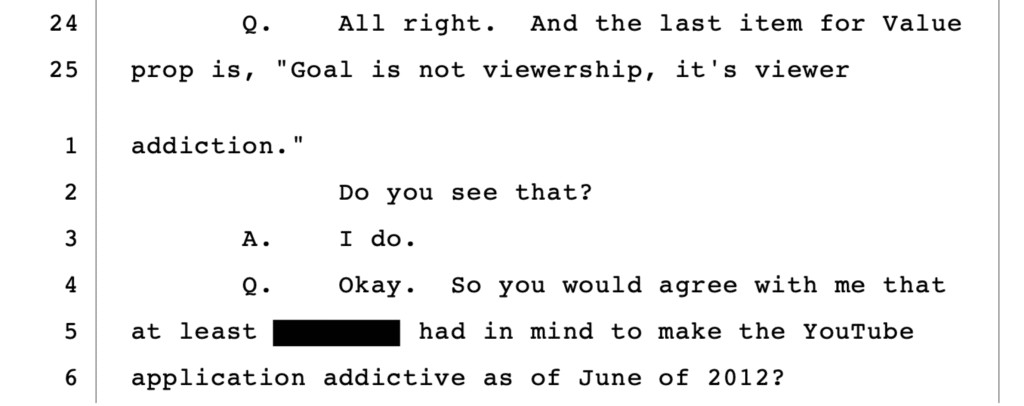
A 2012 YouTube document admitted the company was not measuring user well-being effectively and described its goal as "viewer addiction."
Internal Research Showed Teens Were Harmed
In 2023, Google specifically targeted teenagers with YouTube Shorts despite internal research identifying the feature's "two biggest challenges for teen wellbeing": low-quality content recommendations "that can convey & normalize unhealthy beliefs or behaviors" and "prolonged unintentional use" displacing "valuable activities like time with friends or sleep."
Targeting kids at school
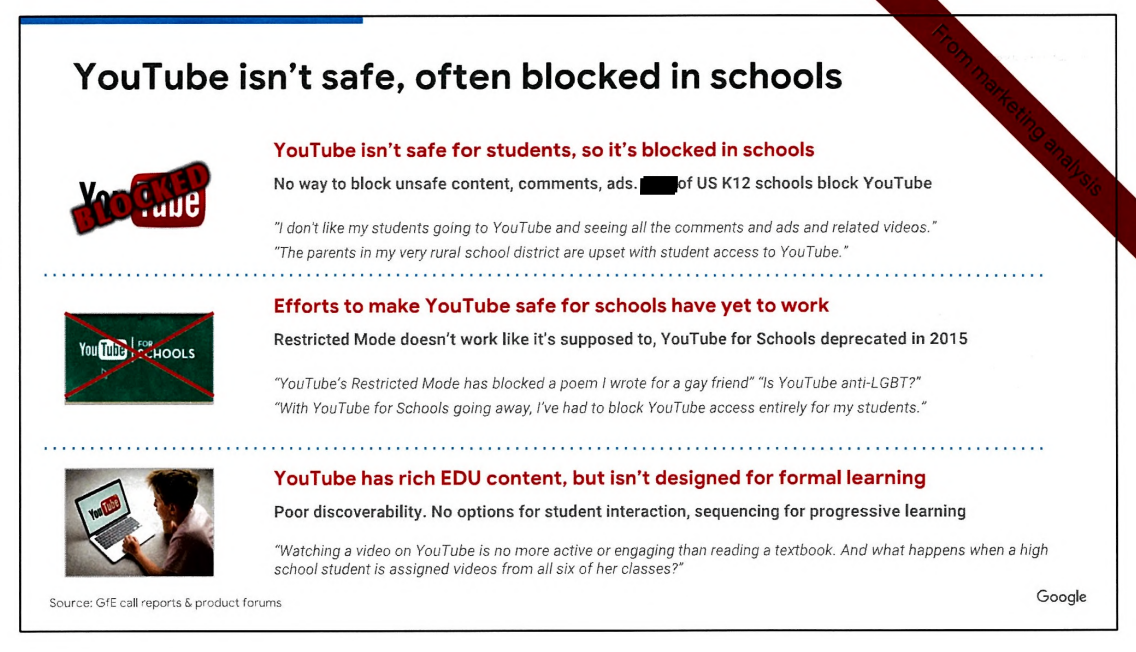
An internal message read: "Engaging the vast majority of teens in an area / school with our products is crucial to driving overall time spent in the same area, especially for Messaging features."