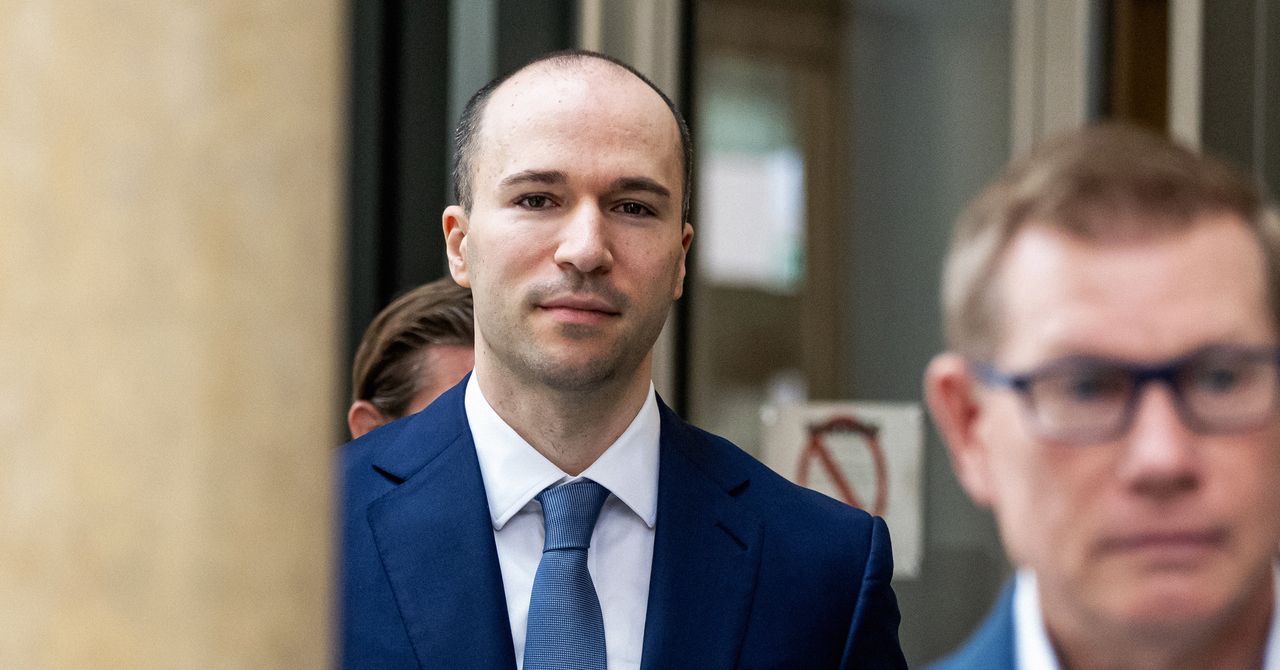
Survivor Parents Tell Congress: Subpoena the CEOs
This week in The Dispatch: A delayed hearing is a chance to subpoena Big Tech's CEOs; California takes on AI that spies on workers; the data center revolt goes national

Welcome back to The Dispatch from The Tech Oversight Project, your weekly updates on all things tech accountability. Follow us on Twitter at @Tech_Oversight and @techoversight.bsky.social on Bluesky.

🔍 BIG TECH INVESTIGATION WATCH: In the wake of bombshell allegations from Meta whistleblower Sarah Wynn-Williams, the Senate Judiciary Committee and down-dais Senators have probed Meta for answers related to the company's business in China, how they helped the CCP build censorship tools, and the national security concerns related to Meta gifting powerful AI tools to Chinese companies to curry favor Xi Jinping and the CCP.
The problem? In an unprecedented move, Meta has refused to cooperate with the roughly dozen document requests from the Senate Judiciary Committee and its members – ALL WHILE REFUSING TO DISPUTE WYNN-WILLIAMS CLAIMS. Zuckerberg and company are literally trying to bankrupt Sarah Wynn-Williams, in an effort to prevent future whistleblowers, while stonewalling Congress and refusing to provide any evidence to the contrary (we bet they can't). That isn't sitting well with Senator Josh Hawley.
Late last week, the Senator opened yet another investigatory request into Meta – this time focused on the company lying to Congress, obstructing Congress from carrying out its oversight responsibilities, and abusing the legal system to muzzle Wynn-Williams and future whistleblowers. It's crystal clear that Meta has a blatant disregard for the American people and is going to extreme lengths to cover up its wrongdoing. Congress needs to keep the pressure up and make sure Mark Zuckerberg has to testify under oath and answer for putting our national security at risk.

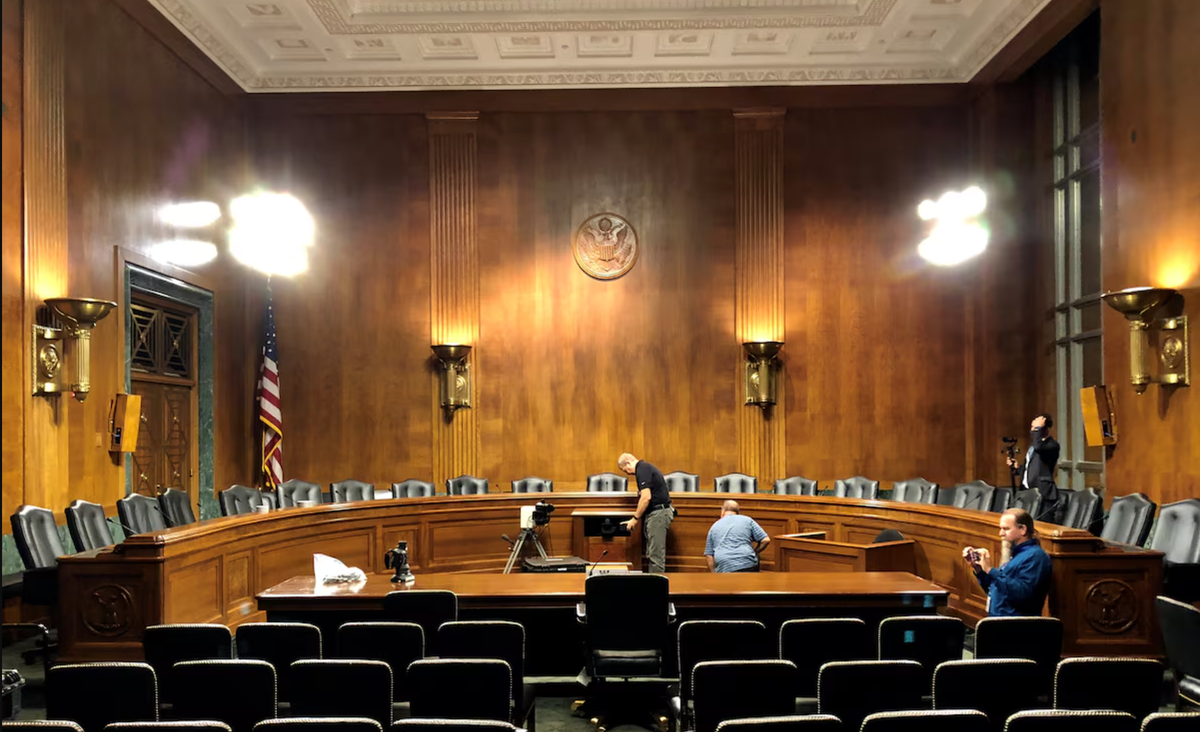
SURVIVOR PARENTS TO CONGRESS: DON'T LET BIG TECH CEOs OFF THE HOOK: The high-profile Senate Judiciary Committee hearing featuring tech CEOs testifying on kids' online safety was originally set for next Tuesday, but has been indefinitely postponed following the death of Sen. Lindsey Graham. The late senator's memorial services fall on the days the hearing was scheduled as well as the day after, meaning the Senate Commerce Committee's expected markup of its chatbot safety package is also up in the air.
The delay is providing Big Tech a chance for the CEOs to dodge the limelight, yet again. Initial reporting had Meta CEO Mark Zuckerberg and Google CEO Sundar Pichai among the likely names, but new reporting shows the two CEOs may be spared personal appearances after the Trump administration intervened on their behalf, allowing them to avoid accountability and send their underlings instead.
Parents who lost children to these platforms won't accept that. In a letter to Committee Chairman Chuck Grassley and Ranking Member Dick Durbin, thousands of parents organized by Parents RISE and ParentsTogether Action have demanded the committee subpoena Zuckerberg and Pichai directly."
As long as the men who made the decisions that killed our children are allowed to hide behind their lower-ranking employees," they wrote, "there will be no real accountability – and we will see no real justice." They're backing it up with a phone drive to Grassley's office. Durbin's office says he supports subpoenas, just as when he chaired a similar hearing in 2024.

👁️ DON'T SURVEIL ME, BRO: California Takes On AI Workplace Surveillance. This is what AI on the job can look like: Twenty-six Meta employees have filed a lawsuit alleging the company used AI to help decide who to cut in its layoffs of roughly 8,000 workers – and that the system was rigged against the most vulnerable people on staff. According to the complaint, Meta built its termination list using keystroke monitoring, activity tracking, AI token-usage dashboards, and algorithmic performance rankings, with little of the individual human review the law requires.
The design is the problem. Those productivity scores, the plaintiffs say, can't be earned by someone who's out on medical or family leave, or whose output is reduced by a disability – so the system pushed sick, pregnant, and caregiving workers toward the cuts. All 26 plaintiffs had taken protected leave; their layoffs are set to begin July 22. It's believed to be the first case challenging AI-driven layoffs at a major U.S. company, and it won't be the last.
This isn't only happening in tech: new reporting shows Kaiser Permanente has deployed AI that monitors how long nurses spend with patients, and staff say they're penalized for spending too much time providing care. When an algorithm punishes a nurse for spending time to go through medical details with a frightened patient, something has gone badly wrong. If a trillion-dollar company will turn these tools on its own white-collar employees, no worker in any industry is safe from them without real rules.
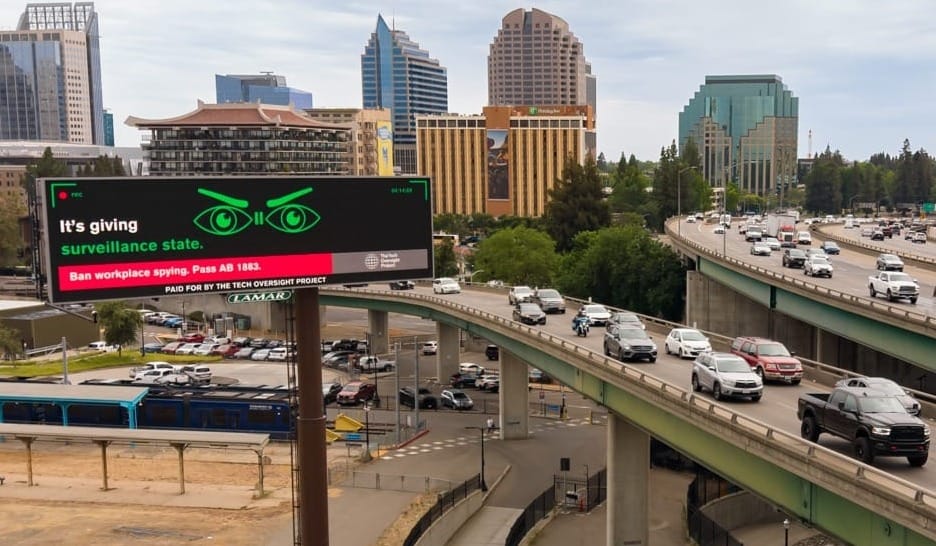
That's why California's AB 1883 matters. Authored by Assemblymember Isaac Bryan and currently in the Senate Appropriations Committee, this bill would prohibit most AI workplace surveillance. Tech Oversight California is pressing for passage with a billboard ad campaign calling out these employer policies for what they are.
Tech Oversight California’s Sacha Haworth: “CEOs are tracking workers’ heartbeats, scanning their faces, and logging every keystroke — with zero rules and zero consent. No one should be tracked all shift and fired by an algorithm.”

⚡️ FIRST IN THE NATION: Last week, New York imposed America’s first statewide moratorium on new hyperscale data centers, with Governor Kathy Hochul announcing a one-year pause while the state conducts an environmental and energy review. Hochul also signaled support for ending generous tax breaks for large data centers, arguing New Yorkers shouldn't be left footing the bill for Big Tech's expansion. State Senator Kristen Gonzalez, who has led the push for stronger oversight, deserves real credit for moving this – a bill she sponsored, now awaiting Hochul's signature, would go even further than last week's temporary pause.
But the data center backlash isn't isolated. It's nationwide. This past Saturday, opponents held 142 protests across 42 states – an ideologically diverse wave of anger, with the most events in Texas (18), followed by Georgia, California, and Pennsylvania. In California's Imperial County, demonstrators turned out in 100-degree heat to oppose a project that could draw 260 million gallons a year from the Colorado River.
Even close observers are struck by the scale of the fight. In a New York Times Opinion conversation this week, writers David Wallace-Wells and Robinson Meyer reached for both the Tea Party and Occupy Wall Street to describe the gathering coalition against data centers. What's driving it, Wallace-Wells argued, is a sense of powerlessness -- the feeling that, as he put it channeling an activist, "we're living through this revolution that none of us were agitating for because a select group of very rich and powerful people decided that it was absolutely necessary, persuaded the powers that be to take their hands off the system and let the money do its work." That's the anger showing up in these town halls. Americans don't want to foot the bill for infrastructure that raises their energy costs and drains their water -- and they're organizing across party lines to be heard.
That anger is up for grabs: As Meyer put it, when voters "feel like there's some industry or sector of the economy that's out of control, they reach for Democrats." Which raises the question of what the party does with the opening.

⌛️ TIME FOR “AI POPULISM”: Texas Rep. Greg Casar is leading by example and sketching what the positive case for AI populism can look like. His vision? Stand with workers, consumers, and communities, and make AI serve the public rather than the handful of investors bankrolling it. As Casar puts it, working people "know in their gut that AI right now is going to make a few billionaires into trillionaires while making millions of Americans poorer, less safe, and less free."
When we say "AI populism," what does that mean exactly? It means protecting workers from surveillance, keeping consumers from being price-gouged by an algorithm, and making sure the benefits of the technology are broadly shared. It's rooted in affordability and accountability – two issues that resonate across the political spectrum, and a natural fit for a party looking to show whose side it's on.
this, a million times this. Dems need to be proactive not only about AI policies but standing up to this blatant intimidation play by the largest AI companies. Voters' anger against Big Tech grows by the day and instead of reform their practices or products, they shell out to… pic.twitter.com/6TO59FyEAQ
— Sacha Haworth (@sachalouise) July 14, 2026
The appetite is there: voters are increasingly wary of Big Tech's power, feel powerless to negotiate a new social contract, and lawmakers who lead on accountability are meeting a genuine public demand. As more candidates and Members of Congress find their footing on this issue and as the industry's hundred-million-dollar spending spree continues to raise public eyebrows, expect this issue to be a salient one at the ballot box.

🗳️ THE AI MIDTERMS: Over the past year, TOP has commissioned a series of polls tracking how voters feel about AI and Big Tech. Our data tells a clear story: people want stronger guardrails, not fewer. They don't trust tech CEOs to write the rules, they oppose stripping states of the power to regulate AI, and they want companies to pay for the costs their products impose on workers, families, and communities.
Here are a few numbers that stand out:
- 61% say Big Tech has too much influence in Washington.
- 51% say AI will undermine civil discourse in our democracy.
- 75% support Congress passing federal legislation forcing Big Tech companies to pay for the increased energy demand their data centers require.
- 58% of voters oppose clearing the way for Big Tech companies to construct massive data centers that consume large amounts of water and land and pollute local resources.
- 72% overall support a Big Tech Tax to ensure the industry pays its fair share, with 86% of Democrats, 60% of Republicans, and 70% of independents in favor.
Voters aren’t anti-innovation – they want it paired with accountability. And they expect their elected officials, not tech executives, to write the rules — no matter how much lobbying cash the industry throws at statehouses and D.C.

 Kaitlyn Huamani
 Sawdah Bhaimiya
 Lucas Ropek
 Matthew Urwin
 Queenie Wong
 Maxwell Zeff