The AI Election Comes Into Focus, An Iowa Survivor Parent's Goal: CEO Subpoenas
This week in The Dispatch: Tech accountability is a winning issue; anti-AI sentiment cuts across the political spectrum; Zuckerberg works the phones at the White House; and Google lobbies for loopholes in state chatbot bills

Welcome back to The Dispatch from The Tech Oversight Project, your weekly updates on all things tech accountability. Follow us on Twitter at @Tech_Oversight and @techoversight.bsky.social on Bluesky.

🏈 TRUMP IS FUMBLING THE BALL: Donald Trump built his political career on stoking the flames of things voters were already angry about. But on AI and data centers, he found the furious voters – then sided with Big Tech.
As Dan Merica wrote in the Washington Post last week, “it has been stunning to see this president, someone known for his sharp political instincts, so firmly position himself on the unpopular side of the debate around artificial intelligence and data centers.”
All of Trump’s rhetorical tactics have been thrown at the backlash. He called AI fears a "hoax." Communities that turn down data centers will end up "backwards and poor," he posted a few weeks ago, and if they "kill the Golden Goose," they'll have only themselves to blame. But voters aren’t buying it. Six weeks from Election Day, NBC's latest poll finds 57% of Republicans, 71% of independents and 81% of Democrats oppose a data center in their community. And 71% of Americans, including 68% of Republicans, say AI is moving too fast.
The adviser with the most sway over Trump on AI, The Guardian reports, is David Sacks, the billionaire venture capitalist and former White House AI czar the paper calls Trump's "AI whisperer." Sacks keeps counseling Trump to let Big Tech dictate AI's future, but Treasury Secretary Scott Bessent and chief of staff Susie Wiles have reportedly urged Trump to mandate more oversight. Trump keeps siding with Sacks.
Sacha Haworth, Executive Director of The Tech Oversight Project, told the Guardian: "Running the David Sacks playbook on AI might be the biggest miscalculation the Trump administration has made. He is an out-of-touch Silicon Valley radical who wants to replace humans with machines. You cannot put this guy in charge and not expect to pay a political price. Republicans are going to follow big tech executives right over a cliff."
Some cautious Democratic consultants are reportedly warning their clients not to poke the AI bear. But the party's own electeds, candidates, organizers and campaign staff say the opposite. More than 170 Democratic operatives signed a letter urging the party to hold the line and publicly decline money from Leading the Future, the Super PAC backed by Big Tech executives from OpenAI, Palantir, and Andreessen Horowitz. The Dem operatives call the industry’s attempt to buy public opinion “fundamentally at odds with the Democratic Party’s core values.”
MS NOW reports that Trump sat down privately with OpenAI's Sam Altman backstage at the Republican midterm convention. Trump has since called AI safety fears a hoax. Trump is fumbling the ball. Democrats need to capitalize on his mistakes.
Voters want guardrails, and Democrats are beginning to listen. As Haworth told the Washington Post: “Democrats are rightfully realizing that running on tech accountability, especially in battleground states and battleground districts, is going to be a winning issue.”

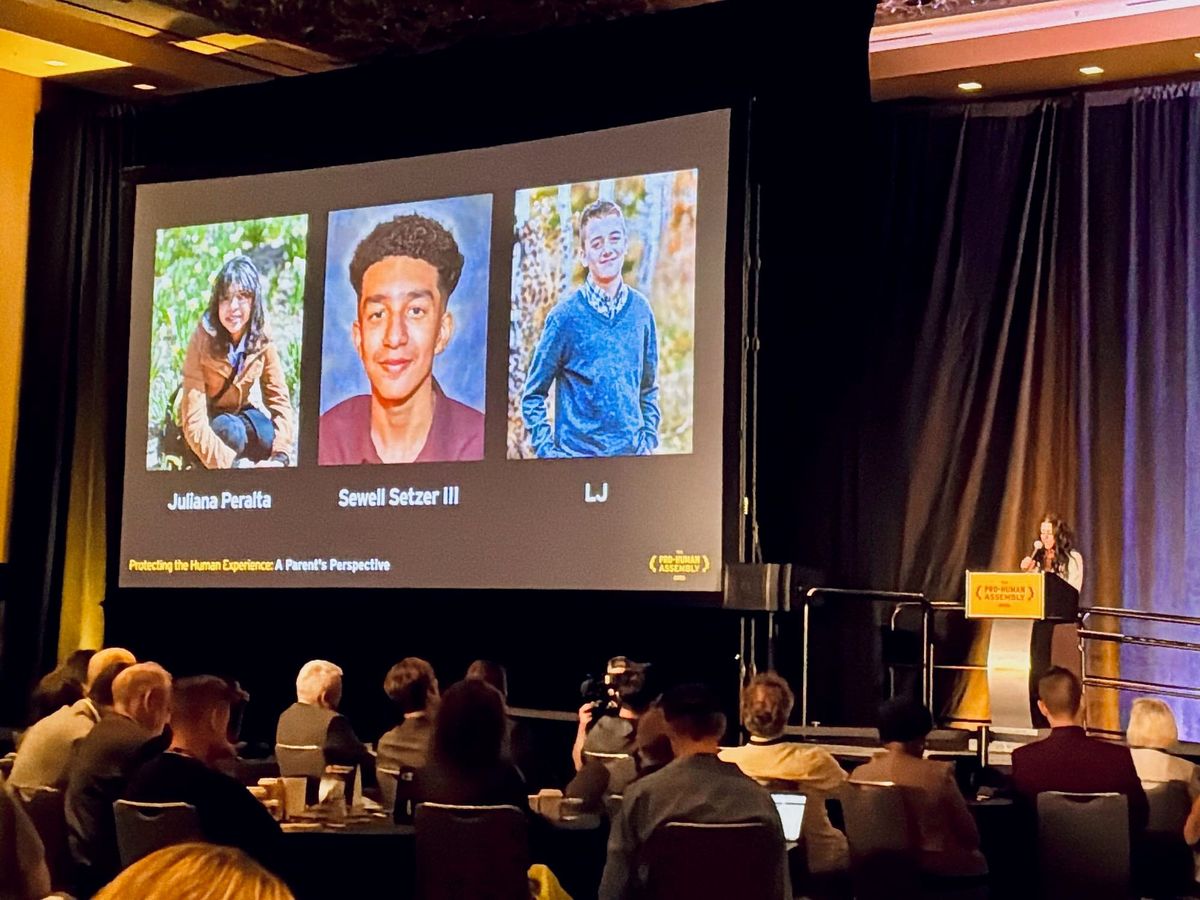
✅ A PRO-HUMAN ASSEMBLY: Nearly 300 people packed a Washington ballroom last Tuesday for the Future of Life Institute's Pro-Human Assembly, where Bernie Sanders and Steve Bannon spoke separately but found the one thing they agree on: the AI industry can't be left to police itself.
"When you are racing towards a cliff, you hit the brakes," Sanders told the room. Bannon, moments later: "We're not doomers. But we aren't gonna give these guys carte blanche."
The most emotionally intense session of the day featured parents of children who had committed or attempted suicide after compulsive use of AI chatbots, as the Boston Globe reports. “I am terrified what happens if we don’t do anything about it,” said Mandi Furniss of Gilmer, Texas.

🤖 COPY, PASTE, EXEMPT: Google Is Seeking the Same Loopholes, Statehouse After Statehouse: A blockbuster NPR investigation finds that chatbot safety bills in at least 10 states share similar language, including exemptions that could cover the biggest chatbots on the market. Lawmakers, lawyers, and advocates NPR interviewed describe a lobbying push led by Google to weaken the bills and hand legislators its own model bill. In Colorado, a Republican lawmaker says a Google lobbyist was "shopping" a chatbot bill around the Capitol.
Colorado shows what that looks like. Its chatbot law, signed in May, exempts twelve categories of chatbots. ChatGPT, Copilot, and Claude could all argue they qualify as developer tools, and Gemini could claim the search-engine exemption.
Cynthia Montoya's daughter died by suicide after concerning interactions with AI chatbots. When Montoya read Colorado's bill, she found loopholes that let the biggest chatbot makers off the hook and testified against it. Lawmakers held side conversations while she spoke, she says, and outside the hearing she watched two tech lobbyists pull them aside one by one.
Marjorie Connolly, Communications Director of The Tech Oversight Project, told NPR: "Bills that were sold as child safety arrived with loopholes already built in.” Of Colorado, she added: “Parents are being asked to accept a chatbot law that exempts chatbots."
Not every governor signed off. Arizona Gov. Katie Hobbs vetoed her state's chatbot bill, saying it protected tech companies more than kids.
Advocates in states that swallowed the industry line are already pledging to come back next session with stronger proposals. Some held firm: a strong chatbot bill spearheaded by Sen. Kristen Gonzalez and Asm. Alex Bores passed the New York legislature without any carveouts. Gov. Kathy Hochul has until the end of the year to sign it — and prove that Big Tech’s money can’t buy the industry’s way out of regulation.

📓 NEW PROBLEMS, SAME PLAYBOOK: How Mark Zuckerberg Is Encouraging the AI Industry to Adopt Social Media Era Playbook: Over the last week, Mark Zuckerberg and other Big Tech CEOs have been posturing on AI safety – in an effort to enact their specific plans to benefit the industry over working people. While Anthropic is posturing on safety and insisting on the need to slow down frontier development, in a surprise to absolutely no one, Meta CEO Mark Zuckerberg essentially said, "Nah. We're good."
Zuckerberg argued that market incentives and legal liability will keep labs honest. Nvidia CEO, Jensen Huang, told a conference that Big Tech should "run as fast as you can." Interesting. Mark "move fast and break things" Zuckerberg knows better than anyone that market forces were not enough to force Meta to design its platform safely for kids or anyone. Zuckerberg and Huang are encouraging AI to run back the same social media era playbook that allowed Big Tech to exploit our economy, our families, and our way of life.
Zuckerberg isn't keeping his position to himself; he's taking it to the President. The Wall Street Journal reports that behind the scenes, Zuckerberg, Elon Musk and Huang each called Trump separately to kill a proposal for an industry-funded, FINRA-style AI regulator. And months before, a Zuckerberg call with Trump is credited with stopping the Administration from releasing an Executive Order on AI that addresses safety risks and hacking from the labs.
With years of drip, drip-style whistleblower reports, thousands of lawsuits from parents, young people, school districts, and Attorneys General, and real-world examples of children who have died from dangerous and addictive social media designs, Mark Zuckerberg is exactly the wrong person to influence how the AI industry approaches safety. Against a mountain of evidence proving wrong-doing, Meta continues to settle out cases rather than confront the full truth.
PILING ON: In yet another example of Meta's misdeeds, the Tech Transparency Project found 332 Meta ads containing AI-generated child sexual abuse material, some built from photos of real kids, including a young member of a European royal family and a 14-year-old influencer. TTP says more kept appearing after Meta announced "better detection."
Zuckerberg needs to be hauled in front of a Congressional committee. More than 50 parents who blame social media for the deaths of their kids are urging Senate Judiciary Chairman Chuck Grassley again to compel his testimony. Their argument: Meta's August settlement is reason enough to bring in the CEOs, not just subordinates. Grassley's planned hearing with lower-level Meta staff was set for July, got delayed, and still has no new date. Grassley chairs the committee. The parents are asking him to use that power.

🦺 AI SAFETY AT EVERY LEVEL: The Human Costs So Far: Last Thursday, Rep. Pramila Jayapal, co-chair of the Monopoly Busters Caucus, ran a shadow hearing with Reps. Chris Deluzio, Greg Casar, Chuy García, Ro Khanna and Delia Ramirez. The witnesses put the human cost of AI on full display.
Leila Turner-Scott's son Sam Nelson was 19. She told members that ChatGPT's memory features, set on by default, flattered him with personal nicknames and inside jokes to keep him coming back, and that hours before he died, ChatGPT advised him it was safe to mix Kratom and Xanax – even giving precise dosage amounts – a combination that proved deadly.
Dr. Jason Sattizahn, the Meta whistleblower, told members that AI surveillance is already inescapable in the technology we use every day. Amba Kak, a former FTC adviser and co-executive director of the AI Now Institute, testified that we already know how to govern powerful industries like banks and utilities – many uses of AI fall under existing laws. Eliza Pan of Amazon Employees for Climate Justice said Amazon is spending more than $200 billion this year – she says to force data centers into communities.
Jayapal announced she will soon release a bill to establish a federal charter for AI companies, a national license to operate like the ones banks get.

📊 BIG TECH'S AI POLLING PROBLEM: A sweeping new roundup from Public Citizen pulls together multiple polls showing the same thing: Americans want real, comprehensive, mandatory regulation of AI — and they want it across parties. Some highlights:
- 78% of voters support mandatory AI regulation over other approaches.
- 71% — including 68% of Republicans — say the pace of AI development is moving too fast.
- 86% — including 83% of Republicans — want a guaranteed off-switch for AI.
- 82% say companies shouldn’t build smarter-than-human AI until they can demonstrate control.
- 80% of Americans support government safety and data-security rules for AI, even if that means developing the technology more slowly.
- 72% want more regulation of the AI industry.
- 65% say the government has done too little to regulate AI.

 David Moore
 Jason Koebler
 Ariel Zilber
 Miranda Nazzaro
 Hugo Lowell