The AI Election: Today, Voters Have Their Say
This week in The Dispatch: How tech & AI accountability has shaped electoral messaging nationwide, what new court documents reveal about a Meta ‘whisper campaign,’ and NY’s new AI chatbots protections for kids

Welcome back to The Dispatch from The Tech Oversight Project, your weekly updates on all things tech accountability. Follow us on Twitter and Bluesky.

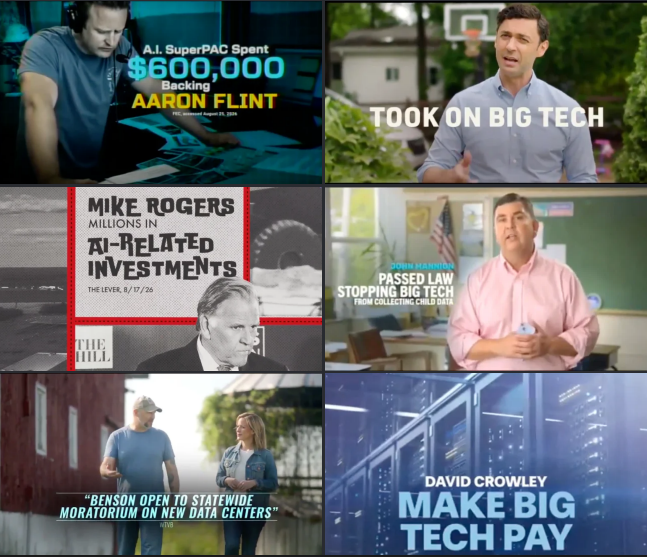
📊 THE STATS BEHIND DEMOCRATS' BIG TECH PITCH TO VOTERS: All year, we’ve said that fighting back against Big Tech data centers, its corrupting influence on Washington, and taxpayer-funded handouts for the industry is a winning message. The results are in, and Democratic party candidates across the country used a strong tech accountability message to draw contrast with their Republican opponents in their paid media push to voters.
In our special report, The AI Election: How Democrats Are Campaigning on Tech Accountability to Win Control of Congress, we monitored races across the country and were pleasantly surprised to find over 135 races using tech accountability messaging, including 100 house races, 20 gubernatorial races, and 17 Senate races. Here's what we found:
- Democratic campaigns used tech accountability framing by a 4-to-1 margin over Republican campaigns.
- Democrats in roughly 75% of DCCC “red-to-blue” House races, and 86% of “tossup” Senate races, leaned into anti-Big Tech messaging in paid ads.
- 100% of Democrats in “tossup” governor’s races used anti-Big Tech messaging in paid TV and digital advertising.
The smartest political ads about data centers are tapping into anger that was already there: Americans are worried about affordability, skeptical of promises that corporations will create good jobs, and fed up with a political system that seems to bend over backward for billion-dollar companies that fail consumers time and time again. Ads fell into three buckets:
Democratic campaigns used their paid media programs to draw a direct link between Big Tech and the cost-of-living concerns plaguing middle-class families.
Here's Cait Conley, running against incumbent Rep. Mike Lawler, needling him directly on backing Big Tech's data centers, which are raising utility prices across the district.
Democratic Campaigns pinned a broken Washington squarely on the Big Tech industry and tagged Republicans for perceived corruption.
The ballroom. The AI super PACs. The Trump campaign donations. Tech CEOs feteing Trump in the White House. Republican-backed tax breaks for Big Tech. When the average voter thinks about corruption, they are more than likely taking a maximalist view that encompasses many actions that Big Tech has taken to bend Washington to its will. From coast to coast, this message was used to put individual Republicans on blast for stock trades, campaign donations, and the super PACs supporting their opponents. In Montana's first district, a race that Leading the Future (super PAC backed by OpenAI, Palantir, and a16z) became a salient attack to voters about who Aaron Flint would really be representing in Washington.
Democrats tapped into deeply-rooted and populist injustice by attacking Republicans on tax breaks for Big Tech and data center companies.
In 2025, the Big Tech industry used their connections to President Trump and Congressional Republicans to write themselves billions in tax breaks. Trump’s OBBB was a colossal misread of the political moment, and Republicans are being lambasted in attack ads, not only for tax breaks, but also for voting for a ban on state AI laws that protect families from rising costs, children and teens from harmful products, and everyday people from consumer scams. Here, DCCC Frontliner, Rep. Greg Landsman, slams his opponent for praising the tax breaks Republicans gave them.
Where do we go from here? Democratic candidates across the country made an explicit tech accountability pitch to voters, and if they take control of the House or Senate, they should govern like it. We want to see Democrats use the gavel to expose Big Tech, force Republicans to choose, on the record, between their voters and their donors, and build a proactive tech agenda big enough to carry the party into 2028.

🚨REDBOX ALERT: Last week, we at The Tech Oversight Project launched new research showing the Democratic Congressional Campaign Committee (DCCC) urged roughly half of its most competitive races to put millions of dollars behind paid media linking Republicans to the corrupt Big Tech handouts that are raising costs, endangering families, and enriching Big Tech CEOs at the American people’s expense — and across the country, candidates, their campaign teams, and allied organizations have responded by stepping up their ads (see some examples below).
The DCCC has made the recommendations in its “redboxes,” the race-by-race publicly posted campaign guidance that tells outside groups which messages the party’s strategists believe will move voters. This follows GOP Senate campaign guidance from August, which flagged data centers as a third-rail issue this cycle, in the context of Ohio Sen. Jon Husted’s public advocacy for them — and which triggered AI Super PAC ad spending and the launch of an entirely new Leading the Future super PAC, Building the Future, to shore up the industry’s support.
Nobody paying attention should be surprised. The “data center debate” isn’t just about infrastructure or even the future of AI. It’s about how much households pay for electricity. It’s about water use, displaced rural jobs, and secret deals that force taxpayers to fund the most powerful corporations in the world. They get rich; everyday people pay the price.
It’s an old story — some of the wealthiest oligarchs in history are getting even wealthier on the backs of the rest of us, and Donald Trump and members of Congress are letting it happen — but this year, millions of voters today are saying, “enough.”
THE CLOSING ARGUMENTS: The risks and downsides of data centers and AI have been part of candidate messaging throughout the year — and increasingly over the past few months, as Democrats and some Republicans have realized that they resonate with voters. Silicon Valley has spent a fortune trying to change the subject. Last week, TOP’s Sacha Haworth joined Phil Aroneanu of Irreplaceable and Adam Billen of Encode AI to discuss where the AI super PAC money is going, how battleground candidates are running on tech accountability and data centers, how grassroots pressure moved the Overton Window on AI safety, and the fights a Democratic majority — if one is elected tonight — should take up first.
“For the first time, the balance of power in Congress will be determined by how voters feel about Big Tech and AI. Battleground campaigns are putting millions behind ads blaming Republicans for letting Big Tech help erase millions of jobs, jack up utility and grocery bills, and corrupt Washington with sweetheart tax deals and data center handouts. If Democrats take back control of Congress, they need to govern how they campaigned: by putting Big Tech to the sword, investigating them for corruption, and rolling back the handouts and giveaways that Republicans gave them,” said Sacha Haworth, Executive Director of The Tech Oversight Project.

📂 WHISPER CAMPAIGN: Newly unsealed court documents show Meta employees discussed a “whisper strategy” to turn academics against their colleague, prominent social media critic Jonathan Haidt — the latest sign the company has worked to protect its image rather than fix the harm its products do. We’ll keep cataloging records like these in our Big Tech on Trial evidence library.

🗽SIGNED INTO LAW: New York’s S9051/A10379, authored by Senator Kristen Gonzalez and Assemblymember Alex Bores, was signed into law last week by Governor Kathy Hochul. New York kids and families will now have the strongest youth AI chatbot protections in the country. The new law sets a national bar for how AI companies must design their products, barring them from building chatbots to simulate companionship and foster emotional dependency with young people.
TOP’s Sacha Haworth: “New York just showed the country what it looks like when lawmakers put our kids ahead of Big Tech’s bottom line. Big Tech sent an army of lobbyists to Albany to derail these critical protections for kids – and they lost. We’re grateful to Senator Gonzalez and Assemblymember Bores for their leadership and to Governor Hochul for signing a strong bill passed unanimously by lawmakers in Albany into law, and proud to have stood with the survivor parents, young people, and advocates who refused to back down.”

💰 THE KANSAS PLAYBOOK: An offshoot of AI Super PAC Leading the Future has spent more than $1.5 million to boost Republican Ty Masterson over Democrat Cindy Holscher in Kansas’ neck-and-neck governor’s race. Holscher’s aggressive push for a data center moratorium early this summer helped her win the Democratic primary. NYT/Siena polling released Sunday showed a tight 48/47 race in the Democrat’s favor.
Holscher: “These billionaire CEOs know that I won’t do their bidding, and that’s why they’re spending millions to beat me. But I’ll keep fighting for guardrails on data centers, and I’ll always put Kansans first.”

 Emily Shugerman and Dustin Gardiner
 Matt Sledge

 Miranda Nazzaro and Julia Shapero

 Shubhangi Goel

 Joe Wilkins