
The New NEW AI Super PAC, Meta's Financial Penalties Add Up
This week in The Dispatch: AI lands top of voters' mind; a judge hits Meta with a record $25 billion; senators grill Google over AI in classrooms

Welcome back to The Dispatch from The Tech Oversight Project, your weekly updates on all things tech accountability. Follow us on Twitter and Bluesky.

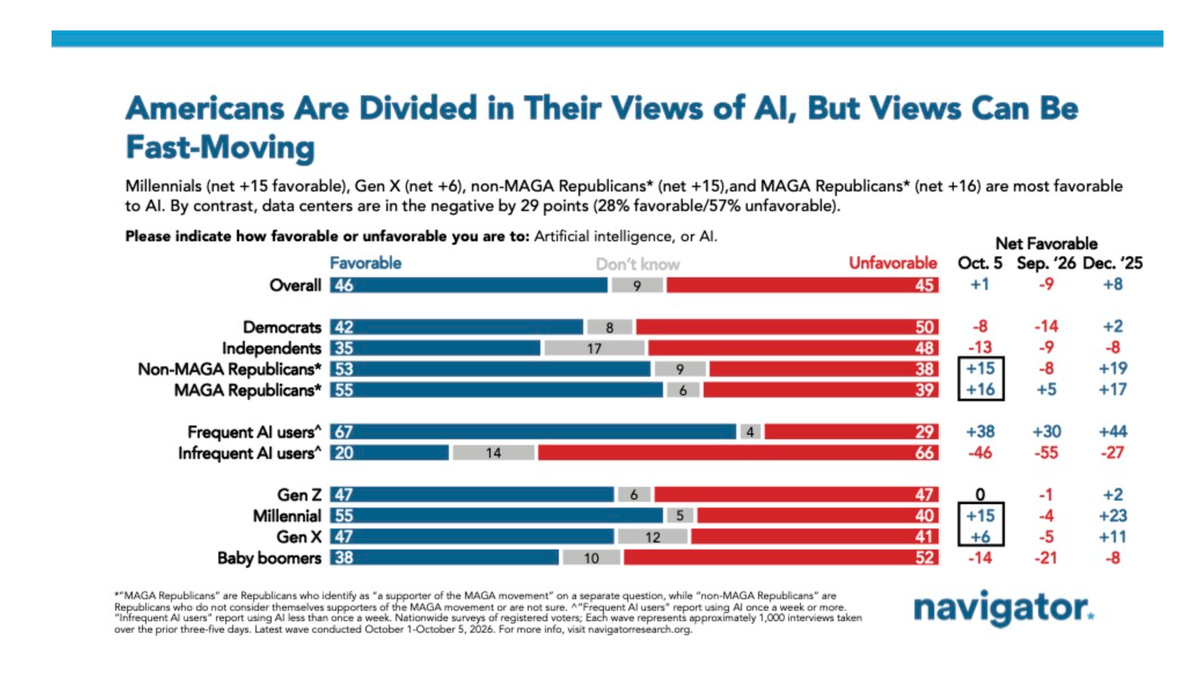
🗳️ THE AI ELECTION: SEVEN DAYS LEFT: This is our last Dispatch before Election Day, and the fight we've covered all year is now shaping how people vote. A new Navigator Research survey finds AI has shot up the list of what Americans want Washington to handle: 21% now rank it among their top five issues for the president and Congress, up from just 7% last December, the biggest jump of anything the poll tested. And they know what they want done about it:
- 66% want more regulation of AI; just 12% want less.
- 52% disapprove of how Trump is handling AI; only 33% approve.
- 56% now use AI every week, up 7 points since December — even 35% of the people who view it unfavorably use it anyway.
These aren't technophobes; the people demanding rules are the same ones using the tools. The industry sees the same numbers, and it's spending to get out ahead of them. Yesterday, the NYT scooped that Leading the Future network, the AI industry-funded super PAC operation we’ve been tracking all year, just opened another dark-money front, Building the Future, running the same playbook against the data-center backlash. It’s reserved $1.5 million to prop up a pro-data-center senator, Darline Graham (R-SC), against a challenger running on data center accountability, and it says South Carolina is only the start.
PSA: this isn't a new super PAC, but merely another dark $ org in the @LeadingFutureAI network, running the LTF playbook: https://t.co/RpoxvidHZk pic.twitter.com/l0Wf0lyVDb
— Sacha Haworth (@sachalouise) October 26, 2026
One week from the election, the lines are drawn: voters want guardrails, and the industry is spending millions and millions in a last-ditch effort to drown out the voices of voters who aren’t buying their spin.

🧑⚖️ JUSTICE IN NEW MEXICO: A state judge ordered Meta to pay $25 billion last Wednesday for deceiving Facebook users about their privacy, the largest fine ever against the company. The case stems from the Cambridge Analytica scandal, in which as many as 87 million Facebook users saw their data improperly used, and a state jury found more than 43 million violations of the state’s consumer protection law. Judge Francis Mathew called out a “coherent strategy designed to mislead the public,” and cited the involvement of senior Facebook leadership.
New Mexico was the only state to take this case to trial, and as state AG Raúl Torrez notes, when you sue Meta, you win: 48 states “are sharing $459 million for the conduct at issue, and New Mexico just received a $25 billion judgment” all on its own. This is New Mexico’s second major win against Meta this year, after a March jury verdict over its failure to protect kids.
BOTTOM LINE: A judge just found that a “coherent strategy” to mislead the public ran through Facebook’s senior leadership. Parents have asked Sen. Grassley to put Mark Zuckerberg under oath, and a $25 billion judgment is a strong reason to take the ask seriously.

🏫 SENATORS PUT GOOGLE ON THE SPOT: Sens. Richard Blumenthal and Josh Hawley are demanding answers from Google about its push to bring AI tools into schools, raising concerns about students’ learning, critical thinking, and mental health. The bipartisan pair want to know what the company understands about the risks to children, why AI features are built into school technology by default, and what safeguards are in place. They’ve given Google CEO Sundar Pichai until November 2 to respond.
The inquiry follows reporting that some students are becoming dependent on AI for both schoolwork and emotional support. Google is rolling AI into classrooms faster than anyone can show it's safe for the kids using it – the senators want to know why, and so do we.

🗽 SIGN IT AS PASSED: New York has the country's strongest AI-chatbot protections for kids sitting on Gov. Hochul's desk – if she signs them as the legislature wrote them. S9051B, sponsored by State Sen. Kristen Gonzalez and Assemblymember Alex Bores, passed both houses unanimously in June, over heavy industry pushback. It would bar companies from giving our kids chatbots built to simulate companionship and foster emotional dependency and hold the companies squarely accountable for sexually explicit exchanges, nudges toward self-harm, flattery engineered to keep kids hooked, and coaching to keep it all secret from their parents. If Hochul signs it, it takes effect at the start of next year.
Last week, TOP joined The TAG Movement, Reset Tech, Common Sense Media, and Brooklyn Public Library for a public conversation on AI chatbots and concerns about their impact on young people’s safety. TOP's Sacha Haworth moderated a panel with Sen. Gonzalez and Jonathan Haidt, author of The Anxious Generation; an earlier panel, moderated by Common Sense Media's Danny Weiss, brought together survivor parent Julianna Arnold, youth advocate Nick Plante, and Dr. Raashid Khan.
Honored to have shared the stage with @SenGonzalezNY whose precedent-setting bill to protect NY kids from manipulative AI chatbots will set a new strong industry standard. Kids should form relationships with other kids, not AI bots.
— Jonathan Haidt (@JonHaidt) October 21, 2026
When signed by @GovKathyHochul, S9051B will… pic.twitter.com/Wx31IPDaiO
Gonzalez was blunt about why the industry is fighting it: "What makes these chatbots different than social media, but also more dangerous, is that they're built to be sycophantic... when you do that, you have a consumer for life. These are inherently flawed products."
Arnold, who founded Parents RISE! after losing her teenage daughter to a predator who targeted her online, spoke to what these products are already doing: "These bots are interacting with our children in very inappropriate ways, encouraging self-harm, encouraging suicide, and telling them, don't tell your parents... This chatbot bill on Governor Hochul's desk will be the strongest in the country if it gets signed into law."
Read our full recap of the Brooklyn event.

🚨 SEE NO EVIL: Previously unreported court records show TikTok’s own employees repeatedly warned leadership about child safety risks and were frustrated by the response. NPR reviewed the depositions filed by current and former staff in March as part of the sprawling litigation over social media’s dangerous effects. Reagen Maher, who held senior safety and investigations roles from 2021 to 2024, described her months-long “crusade” to get execs’ attention about dangers like these:
- Kids in paid sexual content: Employees warned that children were appearing in sexual content on TikTok Live, which adults could pay to watch through the app, with TikTok taking a cut. According to employee testimony, an internal investigation found children between 13 and 15 in 112,000 Live videos in January 2022 alone.
- Loopholes for kids: Staff identified ways users under 18 could bypass age restrictions and block parental oversight.
- Rabbit holes: TikTok’s former head of safety, Eric Han, wrote about algorithmic “rabbit holes” that keep recommending harmful content, including suicide-related posts. A 2020 draft internal review called social media “inherently dangerous” for kids.
- “See no evil”: The records show TikTok avoided surveying its users’ ages because it feared having to share the results with the FTC.
TikTok’s strategy has been to settle at the last possible moment to try to keep evidence away from juries, but the company faces hundreds of lawsuits alongside Meta, Google, and Snap, and it can’t hide the truth forever. Time for the Senate Judiciary Committee to reschedule its long-awaited CEO hearing, ASAP.

🔁 OUT WITH KAPLAN, IN WITH POWELL MCCORMICK: Meta’s longtime policy chief Joel Kaplan, the Republican operative who built the company's pipeline into Trump's Washington, will leave next year after 15 years. Stepping into the political operation is President and Vice Chairman Dina Powell McCormick, who served in the first Trump administration and is married to a sitting U.S. senator, Dave McCormick (R-PA). (She also co-leads Meta's massive AI-infrastructure buildout.) As the Wall Street Journal reports, Meta is handing its political operation to someone with direct ties to both the Trump White House and the U.S. Senate.
Meta has every reason to want that kind of access. The administration it's cultivating has spent the past two years delivering for the industry: under Trump’s so-called One Big Beautiful Bill, Meta and other tech giants stand to benefit from goodies they’ve been lobbying for for years: expanded R&D deductions, permanent 100% bonus depreciation, and a preserved 21% corporate tax rate. TOP’s analysis found that five major tech companies, including Meta, were projected to receive a combined $75 billion in tax breaks from the restored R&D deduction alone, even as the data centers Meta is racing to build push up families' power bills.Meta’s bet? Put the people closest to the president on the payroll, and the favors will keep coming.

🕰️ A TIMELINE OF FAILURE: In 2024, 14-year-old Sewell Setzer III died by suicide after a Character.AI chatbot fostered an emotionally and sexually abusive relationship with him and reinforced his suicidal thoughts. His mother sued, leading to a settlement, and the FTC opened an investigation into the chatbot company. Then came the Trump administration. According to disclosures in Character.AI’s bankruptcy proceedings, the FTC’s investigation was later paused “without further action” under Trump-appointed Chair Andrew Ferguson — raising serious questions about why federal scrutiny ended while families were still waiting for answers. What other AI companies has Ferguson shielded from scrutiny?
In their bankruptcy filings Character AI disclosed that the FTC opened an investigation into them under Chair Khan, only for it to be closed by the Trump-Vance FTC.
— Douglas Farrar (@DouglasLFarrar) October 19, 2026
No justice for the parents of children who harmed themselves because of their chatbots. https://t.co/kyTIRDG3V9 pic.twitter.com/JkQyZhvBo1
Character.AI has filed for bankruptcy, a move critics say clears the way for Disney to access its technology and hire its staff, while legal claims remain unresolved. A bipartisan coalition of 23 state Attorneys General, including California's Rob Bonta, has filed in the proceedings to stop that from happening on the company's terms. Their investigation, which grew out of the Setzer suit, flagged potential consumer-protection and privacy violations, and they warn that the limits Character.AI recently placed on kids' accounts are voluntary, incomplete, and easy for a new owner to roll back. California's own Adam's Law starts regulating these products in 2027.
TOP’s Sacha Haworth: “This is what these companies get in return for financing Trump's ballroom and god knows what else. Massive corruption before our eyes, and Dems must investigate this when we take back the gavel.”

 Spectrum News Staff


 Lauren Feiner

 Dee-Ann Durbin, Associated Press