
Tech Accountability Is Having A Moment
This week in The Dispatch: the real Nvidia scandal reaches the Trump White House; a tech agenda for Democrats; and Big Tech flops in California.

Welcome back to The Dispatch from The Tech Oversight Project, your weekly updates on all things tech accountability. Follow us on Twitter and Bluesky.

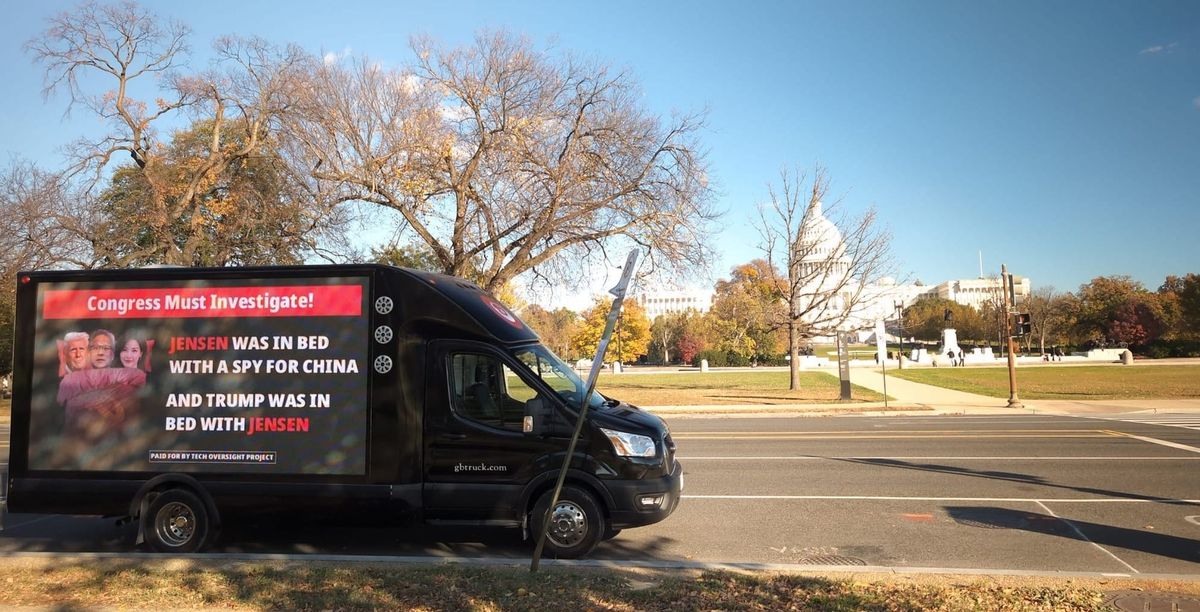
🕵️ THE REAL NVIDIA SCANDAL: Jensen Huang is out as Nvidia's CEO, brought down by a scandal over his relations with an alleged Chinese spy – but administration officials turned a blind eye to this serious national security threat for months. White House AI Czar David Sacks and Commerce Secretary Howard Lutnick spent months boosting Nvidia and its CEO, and both stood to cash in.
Sacks, who runs a venture firm packed with AI bets, invoked Huang more than 20 times to push one line: let Nvidia sell its most advanced chips to China. He worked to scrap Biden-era export limits, and the New York Times reported that both he and Huang stood to benefit. Lutnick promised Huang "really easy access to the President" and called him a "national treasure" – all while Cantor Fitzgerald, the firm he built and controlled, sat on $1.2 billion in Nvidia stock and kept arranging billions in financing for Nvidia's business partners. One China-policy expert put it to CBS bluntly: "Either Lutnick doesn't know how to do his job, or he is protecting Huang."
This is Big Tech capturing the government to pad its own fortunes while chips the US is supposed to control keep flowing to China.
As TOP’s Sacha Haworth told the Washington Post: “Tech accountability was a winning message at the ballot box because of the AI industry’s cozy and corrupt relationship with Trump. Now we are learning Big Tech’s wrongdoing went far beyond corruption. We want to see a Democratic Congress investigate Nvidia for anticompetitive practices that pass off costs to consumers, what the company knew about chip smuggling operations with China, and what Nvidia received in exchange for donations to the Trump campaign and ballroom.”
Want more intel on Sacks and Lutnick? Read our report, and check out the coverage in Ars Technica.

📣 TIME TO DELIVER: In her recent Hill op-ed, “A New Deal for the Age of AI,” TOP Founder & CEO Sacha Haworth says Democrats can’t afford to waste the political opportunity voters just handed them. This is tech accountability’s moment, and the new Congress needs to get moving right away on a 100-day tech & AI accountability agenda.
Sacha joins NewsNation to discuss why Democrats should seize the mandate on AI and tech accountability delivered by voters in this month’s elections to conduct robust oversight and deliver real solutions.
TOP’s Sacha Haworth: “If we can make Big Tech answer to the public and ensure this technology serves all Americans, not just the billionaires who own it, we won’t just earn a coalition big enough to win the White House in 2028. We’ll have a movement built to last, a roadmap for unlocking our potential, and a future where our country is reaching for its highest heights.”
Read Sacha’s op-ed “A New Deal for the Age of AI” here.

🏛️ BIG TECH’S BEST BUDDY IS BACK: Last week House Republicans picked Rep. Jim Jordan (R-OH) as their Minority Leader. Jordan has taken hundreds of thousands in campaign contributions from tech and communications giants over the past twenty years and sent his staff on dozens of trips sponsored by the industry and its front groups. Jordan also hired his staff right out of George Mason University’s Antonin Scalia Law School, home to the Big Tech-funded “Global Antitrust Institute” that advocates for a “hands-off” approach to antitrust regulation.
Jordan has repeatedly voted in ways that benefit Big Tech. He dissented to a Judiciary subcommittee report on antitrust violations, calling it partisan. He objected to merger filing fee reform to fund antitrust enforcement and rejected a bipartisan package of competition bills. His signature "anti-censorship" bill would have stripped the FTC of its enforcement power — one of his own donors’ top priorities. And he led the charge against former FTC Chair Lina Khan, taking attacks further than even his GOP colleagues were comfortable with.
A Google-sponsored Minority Leader? Big Tech could hardly ask for a better ally.

🧭 THE FIRST 100 DAYS: In a memo covered by The Hill last week, TOP laid out our policy plan for the new congressional majority’s first 100 days. We called on Congress to put three priorities ahead of everything else, starting now:
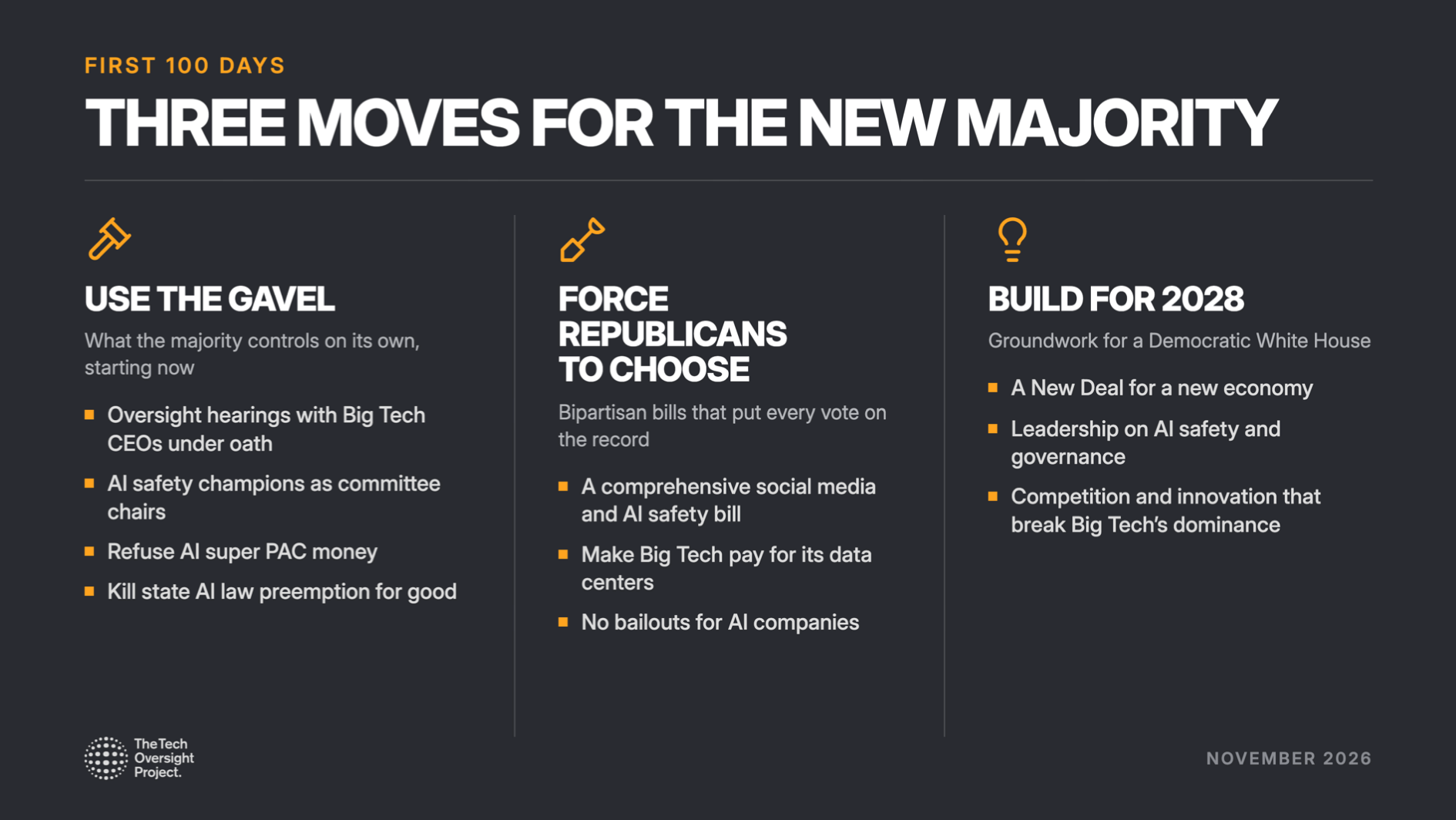
- Deliver powerful oversight. Schedule hearings right away and put Big Tech's CEOs under oath to answer for what their algorithms and predatory AI chatbots do to our kids, what they promised to land data center deals, and what they got for the checks they wrote to Trump. Hearings should put the parents and community members who built this movement at the witness table, alongside the CEOs.
- Put AI safety champions in charge. Committee chairs are being chosen now, and the ones who write AI law will decide how much tech accountability we actually see. As we said in our letter to Democratic leaders last week, candidates for chair and subcommittee chair in key committees should be measured against three standards: support for mandatory, binding AI regulation; opposition to state AI law preemption; and independence from anti-regulatory super PACs like Leading the Future.
- Put the public interest over Big Tech money. New members must pledge to refuse AI super PAC money and oppose preemption — before the industry gets to them. That industry money is politically toxic: three-quarters of likely voters say they'd be less likely to vote for a candidate who took an AI super PAC donation. As we wrote last week, Big Tech is already trying to shape-shift into a Democrat-friendly interest group, but they’re not serious about partnering on policy; they want to be left alone to “regulate” themselves. Don’t let them.
Our 100-day legislative agenda is about ensuring safety, protecting affordability, and ending special treatment for the world’s most powerful companies:
- Pass a comprehensive social media and AI safety bill. It’s time to tackle Big Tech's exploitative design of social media and AI chatbots in one fell swoop, with safety-by-design and privacy-by-default standards for kids modeled on the Kids Codes gaining support across the country. Voluntary commitments have failed. It’s time for Congress to fix it.
- Make Big Tech Pay. Bills already filed by House Democrats would strip data centers of the tax breaks Republicans handed them, make large data centers cover their full energy costs, and ban data center NDAs. They can earn bipartisan support, and Congress should pass all of them.
- No bailouts. OpenAI alone has committed to roughly $1.4 trillion in spending over eight years, and its CFO floated a federal "backstop" for AI financing before walking it back. A no-bailout law costs Congress nothing, puts Republicans on the record, and tells families already paying for Big Tech’s power bills that they won't be asked to cover Big Tech's bets too.
The companies profiting from AI can pay their share, and the workers whose jobs AI is upending can share in the wealth it creates. To make that happen, the 2028 Democratic nominee must promise to lead the world on AI with real safety governance and an agenda that breaks up Big Tech's market dominance. That alliance of parents, community members, workers, and young people isn't going anywhere – and the candidates who stand alongside them in 2028 will have a powerful, unignorable force at their backs. Read the full memo here.

📋 HOW SHOULD STATES SPEND BIG TECH SETTLEMENT MONEY? A new framework from Heat Initiative, Parents Rise!, ParentsTogether, and Design It For Us calls on state attorneys general to put parents and young people with lived experience at the table when deciding how to spend settlement funds. The goal is to make sure those dollars directly support the families and young people most affected. From the framework:
“The harm was designed. The repair must be designed too, and it must be designed with the young people, families, advocacy organizations and communities who lived through it at the center.”

TECH ACCOUNTABILITY: At the races: Big Tech's super PACs spent nearly $47 million on California's legislative races this cycle – their biggest play for Sacramento yet – and a new Tech Oversight California memo finds it failed where the races were actually close.
The industry's two biggest bets went down: tech PACs poured more than $11 million into David Penaloza (AD 68) and Eric Lucan (AD 12), who both lost. Its push to shield Republican incumbents from the Democratic wave flopped too – Greg Wallis, Tony Strickland, and Josh Hoover are all trailing despite the millions spent on their behalf. The "wins" the industry is now claiming came in safe seats it never had to buy – spending meant to curry favor with legislators already headed to Sacramento.
Voters noticed. TechEquity Action ran a seven-figure campaign exposing the spending, and accountability candidates made it an issue: in the Central Valley, Brian Pacheco hit Republican Mike Murphy with an ad that landed on "Mike Murphy for Silicon Valley, not ours."
Even the candidates that the tech industry backed kept their distance – State Senate candidate Sara Hernandez, lifted by nearly $6 million in tech PAC support, told Politico she refused AI and crypto money and is “diametrically opposed” to an unregulated tech and AI industry.

 Brandon Pho
 Ashley Gold
 Leah Nylen

 Maggie Harrison Dupré

 Dara Kerr